Introduction
•The freshwater habitats occupy a relatively very small portion of earth ‘s surface (i.e. 1% only) compared with marine (70%) and terrestrial habitats (28%), but their importance to humans is far greater than their area for the following reason.
1.They are the most convenient and cheapest source of water for domestic, agriculture and industrial purposes.
2.Freshwater ecosystems are bottle neck in water cycle.
3.Freshwater ecosystems along with estuaries provide the most convenient and cheapest waste disposal system. The world‘s largest cities are located on large rivers, lakes or estuaries that serve as afree sewers
•It has been estimated that the total volume of water present on our planet is roughly about 1460 million cubit kilometers.
•97.41% of the total volume is salt water present in the oceans and seas
•the remaining 2.59% of freshwater,
•1.984% is frozen in the form of glaciers and polar ice caps:
•0.59% water is underground
•0.001% is present in atmosphere.
•Thus, the total amount of freshwater present in our streams, rivers, lakes, ponds, reservoirs, etc. amount to 0.13% only.
Types of Freshwater Habitats
•The freshwater habitats can conveniently be divided into two groups, namely.
•a) Lentic or Standing water habitats,
•b) Lotic or Running or Flowing water habitats.
•Both can be considered on an environmental gradient. The lentic involves gradient from lakes to ponds to swamps to marshes. The lotic follows a gradient from springs to mountain brooks to stream to rivers.
Difference between lentic and lotic environment
•Currents are present in the lotic habitats while they are absent in the lentic habitats.
•The reaction between water and land is greater in the lotic environment and lesser in lentic environment.
•Oxygen tension is more uniform in the streams and rivers and there is thermal or chemical stratification as compared to lentic waters.
Lentic Habitats
•Lentic types: Lentic water includes all standing water habitats, such as, lakes, ponds, swamps, marshes, meadows, etc. These may be defined as under:
•a. Lakes: It is very hard to distinguish a Iake from a pond. The term pond is frequently used interchangeably with lake since the question where a body of water ceases to be a lake and becomes a pond has never been settled. A small lake can be termed as a “big pond”, and vice versa, a big pond can be spoken of as small lake.
•Generally, according to leading limnologists, large expanses of standing waters having considerable depth are considered as lakes while small and shallower ones as ponds.
Difference between Lake and Pond
•The lakes, in addition to being larger in size also show some important ecological differences. for example.
•a) in lakes, the limnetic and profundal zones are. relatively large as compared to littoral zone, Whereas in ponds reverse is true and profundal zone is literally absent (Fig. 3.4).
•b) In lakes there is generally a wave action which plays a dominant role in mixing of water where as pond isa quiet body of water,
•c) in lakes, there is generally a stratification of temperature and oxygen (particularly in temperate regions) whereas ponds being shallow water bodies do not show any stratification.
•d) since profundal zone is usually absent in ponds, most of its bottom is covered with rooted vegetation.
•Thus; a lake may be defined as a large body of standing water with a distinct profundal zone and in which wind plays an important role in mixing water.
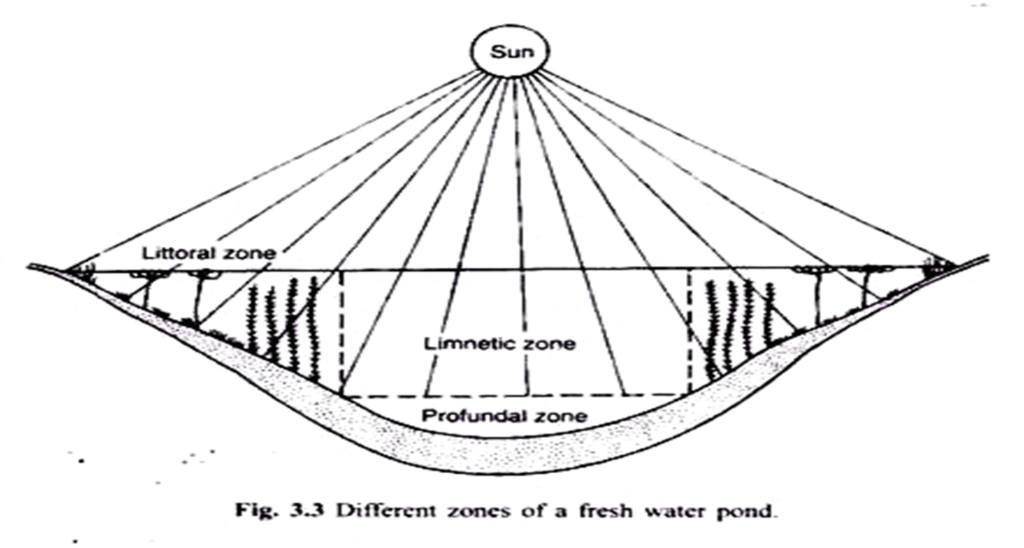
•ii. Ponds: A pond may be defined as a small, shallow, quiet body of standing water usually filled with rooted vegetation.
•iii. Wetlands: Wetlands are ecosystems in which the land surface is saturated or covered with standing water, at least part of the year and the vegetation is adapted for growth under saturated conditions.
•There are specific names for specific kinds of wetlands but we can group them in four categories, namely,
•1) Swamps are wet lowlands which support mosses and shrubs together with large trees; covered with 15 – 30 cm of water. The swamps tend to be associated with flowing water.
•2) Marshes are treeless wetlands with abundant grass, rushes and sedges often covered with 20cm or more water. These also tend to be associated with flowing water.
•3) Meadows are areas without standing water during growing season; water-logged to within few centimeters of surface; grasses short and abundant; serve as pasture ground.
•4) Bogs and Fens are areas that may or may not have trees; soil water-logged that tend to accumulate peat. Fens are fed by ground water and surface run off whereas bogs are fed solely by rainfall.
•Lands covered with freshwater and located away from coastal areas are called Inland wetlands
•The ones covered with saltwater are called Coastal wetlands.
Services Provided by Wetlands
•Wetlands perform following important services:
•1. They support a great diversity of-life forms.
•2. Wetlands act as traps and filter for water that flow through them.
•3. Runoff water is slowed as it passes through the shallow plant-filled areas, reducing flooding.
•4. The loads of sediments are deposited in wetland instead of travelling into rivers, and eventually, the oceans. In this way, wetlands clarify surface waters and help in accumulation and formation of fertile lands.
•5. Chemical interactions in wetland ecosystems neutralize and detoxify substances in water.
•6. Water in wetland seep in the ground, helping to replenish underground water reservoir.s called Aquifers.
•7. Wetlands serve as nesting and breeding sites for a variety of migratory birds.
•Wetlands have suffered severe losses in many parts of the world.
•About half of all the original wetlands have been degraded or completely lost over the past 250 years. In countries like Indonesia, Philippines. Thailand, New Zealand, Portugal as well as 60 – 90% wetlands have been destroyed.
•iv. Reservoirs: Reservoirs are -normally large, deep, man-made bodies of standing freshwaters. Reservoirs store water for domestic, irrigation, industrial or power generation purposes.
•Reservoirs are also used for recreation such as, swimming, angling and boating.
•The size .and shape of reservoir vary according to the region and design of the dam. Often artificial reservoirs are wrongly called as lakes.
Lotic Habitats
•Lotic types: Lotic waters include all types of running waters, such as mountain brooks, springs. streams and rivers.
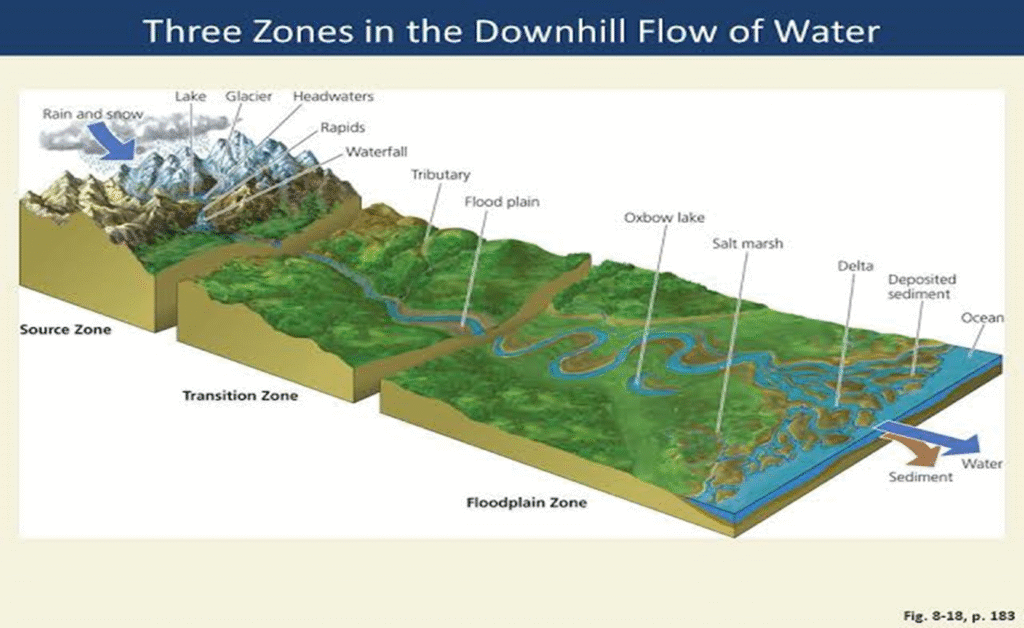
•Of the water that falls on earth, some evaporates, some is absorbed by the soil and percolates downwards to form groundwater, and some flows over the ground as “run off” in the form of streams or rivers which eventually drain into the sea.
•Because of inequalities in the nature of surface rock forms and soil and because land areas have a slope, the runoff of melted snow is. accumulated in smaller gullies, these join to form mountain brooks, which converge to give rise streams and finally rivers.
•The river at its mouth divide into a number of channels or creeks before draining into the sea.
•i. Brooks: Small channels in mountain or marshy are along the seacoast.
•ii. Springs: A spring may be defined as concentrated flow of groundwater issuing from the opening in the ground. Springs may range from tiny seep holes to large fissures in rocks. If the rate of flow is great enough, the runoff water forms a big channel or stream.
•iii. Streams: A stream may be defined as smaller, shallower and cooler body of flowing water. The current is comparatively slow, and bottom consists of gravel stones.
•iv. Rivers:. A river may be defined as a larger, deeper. and warmer body of flowing water: The current is more rapid in upper reaches and water is muddy.
Characteristics of Freshwater Environment
•Freshwater environments, unlike the marine, are subject to variations in the environmental factors such as, salinity, dissolved gases, light, turbidity and others.
•Salinity is one of the most important factors that limits the abundance and distribution of many organisms directly or indirectly. It affects organisms mainly through changes in osmotic pressure and the density of water. The salinity of sea water is fairly constant, averaging 35 ppt. Freshwater have on average a salinity of 0.065 ppt for soft waters and up to 0.3 ppt for hard water.
•Temperature fluctuations both diurnal and seasonal, are more evident in freshwater habitats.
•As diurnal variation of as much as 5° C has been observed in some tropical ponds having a depth of 3.0 meters. Flowing waters, however, lack such wide fluctuations in temperature.
•Temperature exerts a tremendous influence, directly or indirectly, on various limnological phenomena such as, stratification of water, solubility of oxygen, pH, and metabolic activities of plants and animals. Temperature often acts as a limiting factor for freshwater organisms since freshwater animals are mostly steno-thermal in nature i.e. have narrow tolerance of temperature.
Temperature Classification of Lakes
•According to temperature relations, lakes have been classified as
•a) Tropical lakes, in which surface temperature is always maintained above 4°C,
•b) Temperate lakes, in which surface temperature vary above and below 4°C,
•c) Polar lakes, in which surface temperature never go above 4°C.
•Dissolved gasses are often limiting factors in freshwater habitats. Streams and lakes contaminated by sewage or decaying vegetation show an abundance of hydrogen sulphide gas, which is highly toxic to living organisms likewise, methane and carbon-monoxide are also toxic gases.
•Lotic water comparatively has a high percentage of oxygen. Oxygen contents of a freshwater body are depleted in numerous ways. In stagnant pools with a lot of decaying vegetation, oxygen level often reaches a stage of complete depletion.
•For best growth of aquatic life, the oxygen level should be above 5 mg/liter but should not exceed 15 mg/liter. High saturation level of respiratory gases has also been found to have detrimental effects on aquatic biota (e.g. in fishes, it causes gas bubble disease).
•Light in water is a factor of profound importance for its role in photosynthetic process. It is often a limiting factor in the distribution of organisms, particularly, the plankton.
•Turbidity of water depends upon the kind and amount. of suspended material like, silt, clay particles, and the planktonic organisms. Turbidity is inversely proportional to the penetration of light. Hence, turbidity is often a limiting factor in the development of animal and plant life in freshwaters.
•Since water is dense, the direct action of current is a very important limiting factor, especially in streams. Also, currents often largely determine the distribution of vital gases, salts and small organisms.
•Concentration of bio-genic salts, chiefly as nitrates, phosphate, etc. appear to be limiting factor to some extent in the distribution of organisms in freshwaters.
•Freshwater being efficient solvent contains many solutes in solution, but even then, its salt contents remain under 0.5 ppt compared with 35 ppt of seawater. Different dissolved salts reach water by erosion, inflow and decay of aquatic organisms.
•Dissolved salts have peculiar significance for floating aquatic vegetation (roots of which hang freely in water) and phytoplankton as these organisms do not depend on the substratum for the supply of nutrients.
•Nitrates· and ammonia salts are· essential for the aquatic vegetation.
•Ammonia salts in excess have lethal effects on fauna. All freshwater environments also contain small amounts of phosphorus which more often acts as a limiting factor.
•Utilization of phosphorus by phytoplankton during periods of their abundance (or bloom forming period) may result in a total elimination of other plants that require phosphorus.