Standardized Procedure
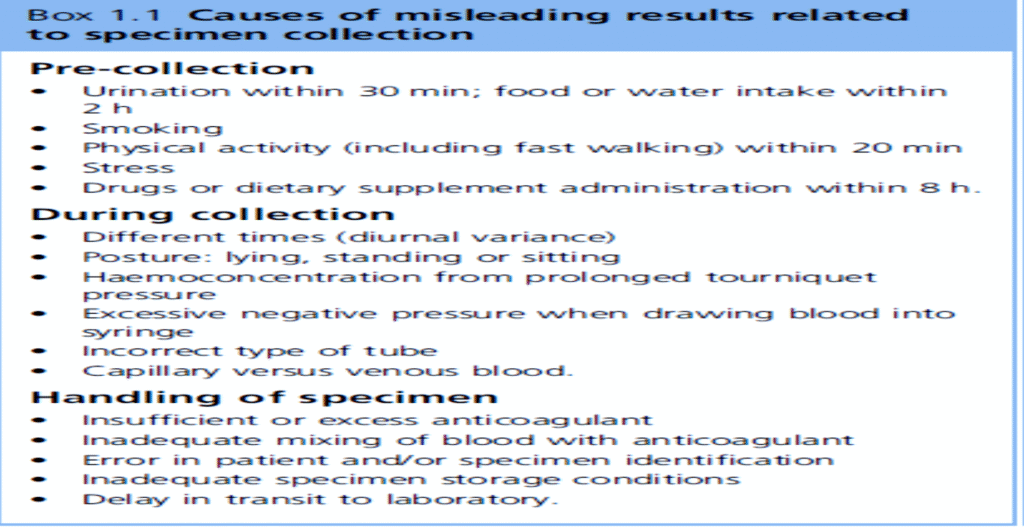
•The constituents of the blood may be altered by a number of factors which are listed in Box 1.1.
•It is important to have a standard procedure for the collecting and handling of blood specimens.
Venous blood
•It is now common practice for specimen collection to be undertaken by specially trained phlebotomists, and there are published guidelines which set out an appropriate training programme.
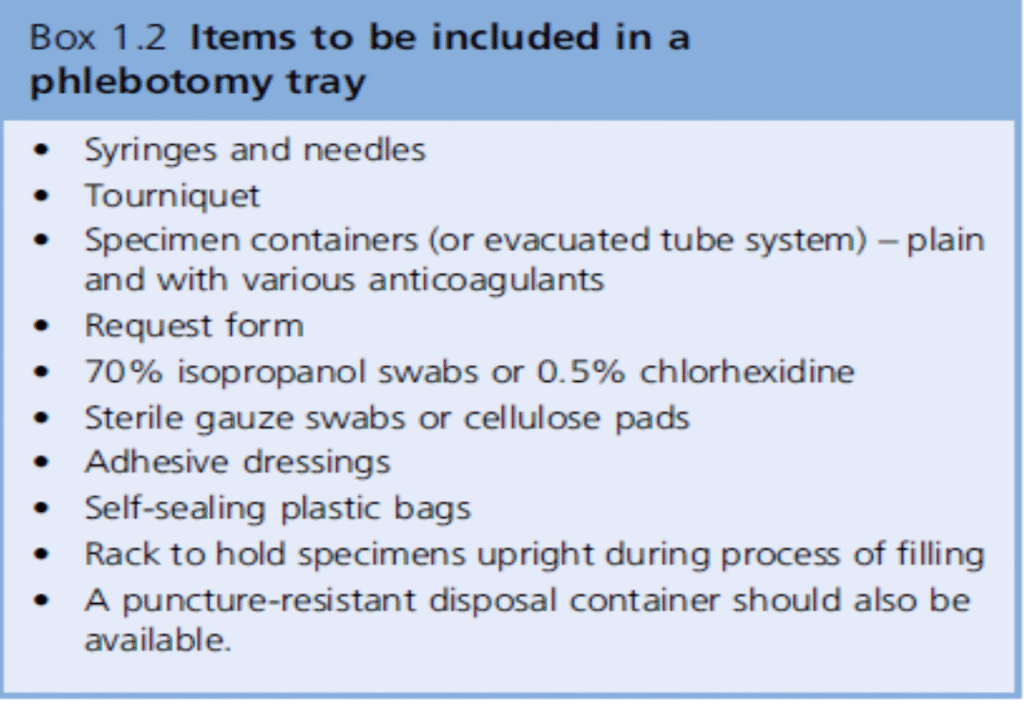
•Phlebotomy Tray
•It is convenient to have a tray which contains all the requirements for blood collection (Box 1.2).
•Disposable Plastic Syringes and Disposable Needles
•The needles should not be too fine, too large, or too long; those of 19 or 21G* are suitable for most adults. 23G are suitable for children and ideally should have a short shaft (about 15 mm).
•It may be helpful to collect the blood by means of a winged (‘butterfly’) needle connected to a length of plastic tubing which can be attached to the nozzle of the syringe or to a needle for entering the cap of an evacuated container.
Specimen Containers
•The common containers for hematology tests are available commercially with dipotassium, Tri potassium, or disodium ethylenediamine tetra-acetic acid (EDTA) as an anticoagulant, and they are marked at a level to indicate the correct amount of blood to be added.
•Containers are also available containing trisodium citrate, heparin or acid-citrate-dextrose, as well as containers with no additive which are used when serum is required.
•Design requirements and other specifications for specimen collection containers have been described in a number of national and international standards, e.g. that of the International Council for Standardization in Hematology, and there is also a European standard (EN 14820).
•Unfortunately, there is not yet universal agreement regarding the colors for identifying containers with different additives; phlebotomists should familiarize themselves with the colors used by their own suppliers.
•Evacuated tube systems which are now in common use consist of a glass or plastic tube/container (with or without anticoagulant) under defined vacuum, a needle, and a needle holder which secures the needle to the tube.
•The main advantage is that the cap can be pierced, so that it is not necessary to remove it either to fill the tube, or subsequently to withdraw samples for analysis, thus minimizing the risk of aerosol discharge of the contents.
•An evacuated system is useful when multiple samples in different anticoagulants are required.
•The vacuum controls the amount of blood which enters the tube, ensuring an adequate specimen for the subsequent tests and the correct proportion of anticoagulant, when this is present. Silicone-coated evacuated tubes can be used for routine coagulation screening tests.
Phlebotomy Procedure
•Blood is best withdrawn from an antecubital vein or other visible veins in the forearm by means of either an evacuated tube or a syringe.
•It is usually recommended that the skin should be cleaned with 70% alcohol (e.g. isopropanol) or 0.5% chlorhexidine and allowed to dry spontaneously before being punctured; however, some doubts have been expressed on the utility of this practice for preventing infection at the venipuncture site.
•Care must also be taken when using a tourniquet to avoid contaminating it with blood because infection risks have been reported during blood collection.
•The tourniquet should be applied just above the vino puncture site and released as soon as the blood begins to flow into the syringe or evacuated tube – delay in releasing it leads to fluid shift and hemoconcentration as a result of venous blood stagnation.
•Except for very young children, it should be possible with practice to obtain venous blood even from patients with difficult veins.
•A butterfly needle is especially useful when a series of samples is required.
•Successful venipuncture may be facilitated by keeping the subject’s arm warm, applying to the upper arm a sphygmomanometer cuff kept at approximately diastolic pressure and tapping the skin over the site of the vein a few times.
•After cleaning and drying the site and applying a tourniquet, ask the patient to make a fist a few times. Veins suitable for puncture will usually become apparent.
•If the veins are very small, a butterfly needle or 23G needle should enable at least 2 ml of blood to be obtained satisfactorily.
•In obese patients, it may be easier to use a vein on the dorsum of the hand, after warming it by immersion in warm water; however, this site is not generally recommended as vein punctures tend to bleed into surrounding tissues more readily than at other sites. Venipuncture should not be attempted over a site of scarring or hematoma.
•If a syringe is used for blood collection, the piston of the syringe should be withdrawn slowly and no attempt made to withdraw blood faster than the vein is filling.
•Anticoagulated specimens must be mixed by inverting the containers several times.
•Hemolysis can be avoided or minimized by using clean apparatus, withdrawing the blood slowly, not using too fine a needle, delivering the blood gently into the receiver and avoiding frothing during the withdrawal of the blood and subsequent mixing with the anticoagulant.
•If the blood is drawn too slowly or inadequately mixed with the anticoagulant some coagulation may occur.
•After collection, the containers must be firmly capped to minimize the risk of leakage.
•If blood collection fails, it is important to remain calm and consider the possible cause of the failure.
•This includes poor technique, especially stabbing, rather than holding the needle parallel to the surface of the skin as it enters, as this may result in the needle passing through the vein.
•After two or three unsuccessful attempts, it may be wise to refer the patient to another operator after a short rest.
•After obtaining the blood and releasing the tourniquet, remove the needle and then press a sterile swab over the puncture site.
•The arm should be elevated after withdrawal of the needle and pressure should continue to be applied to the swab with the arm elevated for a minute or two before checking that bleeding has completely ceased. Then cover the puncture site with a small adhesive dressing.
•Obtaining blood from an indwelling line or catheter is a potential source of error.
•As it is common practice to flush lines with heparin, they must be flushed free from heparin and the first 5 ml of blood discarded before any blood is collected for laboratory tests.
•If intravenous fluids are being transfused into an arm, the blood sample should not be collected from that arm.
Post-phlebotomy Procedure
•The phlebotomist should again check the patient’s identity and must make sure that it corresponds to the details on the request form.
•It is essential that every specimen, as well as the request form, is labelled with adequate patient identification immediately after the samples have been obtained.
•On the labels this should include at least surname and forename or initials, hospital number, date of birth and date and time of specimen collection.
•The same information must be given on the request form, together with ward or department, name of requesting clinician and test(s) requested.
•When relevant, a biohazard warning must also be affixed to the container and to the request form.
•If automated patient identification is available both the label and the request form should be bar-coded with the relevant data unless the sample is to be used for blood transfusion tests, in which case the label should be handwritten, with the name in full.
•Specimens should be sent in individual plastic bags separated from the request forms to prevent contamination of the forms in the event of leakage.
•Alternatively, the specimen tubes must be set upright in a holder or rack and placed in a carrier together with the request forms for transport to the laboratory.
Waste Disposal
•Without separating the needle from the syringe, place both, together with the used swab and any other dressings, in a puncture-resistant container, for disposal. If it is essential to dispose of the needle separately it should be detached from the syringe only with forceps or a similar tool. Alternatively, the needle can be destroyed in situ with a special device, e.g. Sharp-X (Biomedical Disposal Inc: www.biodisposal.com).
Capillary blood
•Skin puncture can be used for obtaining a small amount of blood either for direct use in an analytic process or for collecting into capillary tubes coated with heparin for packed cell volume or into a special anticoagulated micro collection device.
•These methods are mostly used when it is not possible to obtain venous blood (e.g. in infants under 1 year, in gross obesity) or for point-of-care blood tests.
Collection of Capillary Blood
•Skin puncture is carried out with a needle or lancet.
•In adults and older children, blood can be obtained from a finger; the recommended site is the distal digit of the third or fourth finger on its palmar surface, about 3–5 mm lateral from the nail bed.
•Formerly the ear lobe was commonly used, but it is no longer recommended because reduced blood flow renders it unrepresentative of the circulating blood.
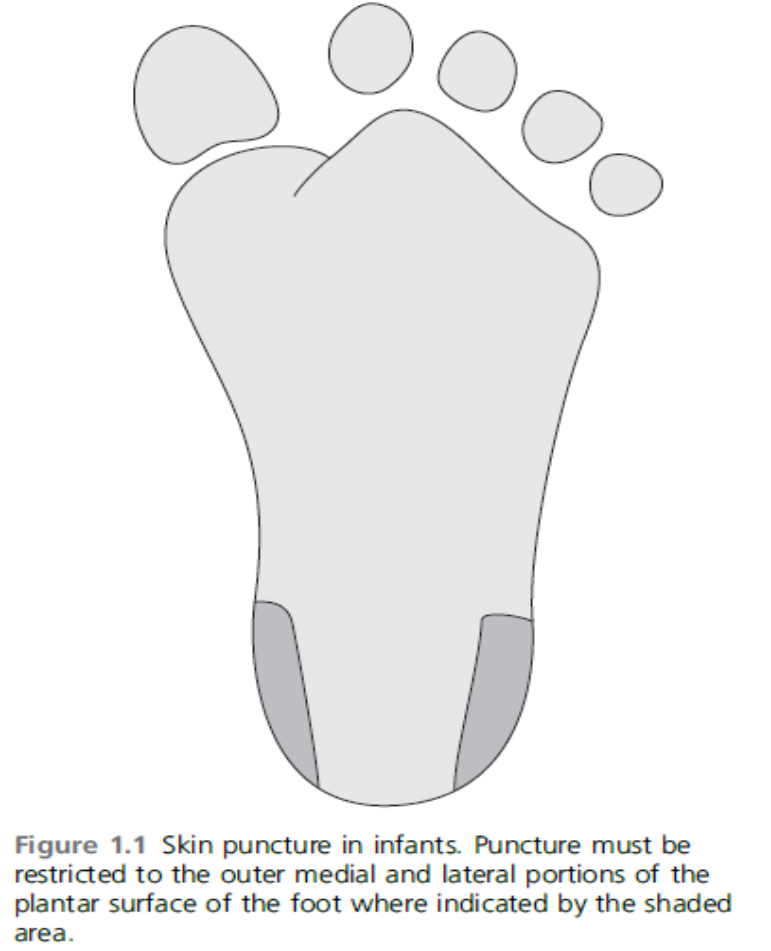
•In infants, satisfactory samples can be obtained by a deep puncture of the plantar surface of the heel in the area shown in Figure 1.1.
•As the heel should be really warm, it may be necessary to bathe it in hot water.
•The central plantar area and the posterior curvature should not be punctured in small infants to avoid the risk of injury and possible infection to the underlying tarsal bones, especially in newborns.
•Clean the area with 70% alcohol (e.g. isopropanol) and allow to dry. Puncture the skin to a depth of 2–3 mm with a sterile disposable lancet. Wipe away the first drop of blood with dry sterile gauze.
•If necessary, squeeze very gently to encourage a free flow of blood. Collect the second and following drops directly onto a reagent strip or by a 10 ml or 20 ml micropipette for immediate dispensing into diluent.
•A free flow of blood is essential, and only the very gentlest squeezing is permissible; ideally, large drops of blood should exude slowly but spontaneously. If it is necessary to squeeze firmly in order to obtain blood, the results are unreliable. If the poor flow is due to the sampling site being cold and cyanosed, too high figures for hemoglobin concentration, red cell count, and leucocyte count are usually obtained.
•There are methods for collecting the blood into a capillary tube fixed into the cap of a microcontainer to allow the blood to pass by capillary action into the container.
•In another system, a calibrated capillary is completely filled with blood and linked to a pre-measured volume of diluent.
•An adequate puncture with a free flow of blood can also enable a larger volume to be collected, drop by drop, into a plastic or glass container.
•After use, lancets (and needles) should be placed in a puncture-resistant container for subsequent waste disposal, and they must never be re-used on another individual.