Introduction
•Community ecology deals with the groups of different kinds of populations in the area.
•A community is defined as an assemblage of different plants, animals, and microbes living in a defined area of habitat. Thus, the forest with various kinds of trees, shrubs, herbs, animals (such as, mammals, birds, reptiles, insects, etc.) fungi and other microorganisms is recognized as a community.
•Communities may be large or small. Some may cover thousands of square kilometers such as forests or an ocean.
•Other such as a swamp, lake or stream may have dimensions in hundreds of kilometers.
•The communities of ponds, tide-flats, mountain meadow occupy a more restricted area.
•The plant and animals living on an isolated stone or rotten log of wood constitute still smaller communities.
Size and Structure of Community
•These various characters used for such purpose are broadly divided into major categories: analytical and synthetic.
•The analytical characters are those, which are directly observed in the field while the synthetic characters are based upon the data obtained for the analytical characters.
•The analytical characters are either qualitative or quantitative depending upon whether they can be expressed and measured in quantitative terms.
Analytical Characteristics
•These are of two types:
•1) Quantitative, which are expressed in quantitative terms,
•2) Qualitative, which are expressed only in qualitative
•terms.
•1. Quantitative Characters: The major quantitative characteristic are as follows:
a. Frequency: Frequency is the number of sampling units (quadrate, transect, point, etc.) in percentage, in which given species occurs
•It is determined by the following formula:

•Thus, the estimate of frequency depends upon the size of the sampling unit.
•A very small sampling unit underestimates the frequency of widely spaced individuals while a large sampling unit overestimates the frequency.
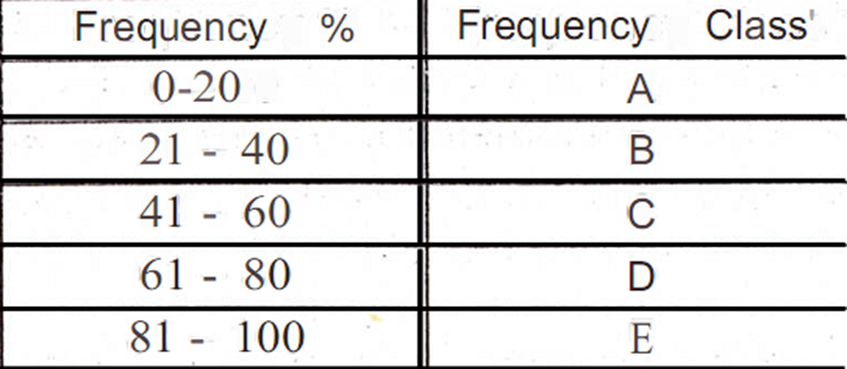
•After determining the frequency percentage of each species, various species are distributed among Raniere’s five frequency classes, depending upon their frequency value as follows:
b. Density: Density represents the numerical strength of the species in the community. it is calculated as follows:

•Density is expressed as number of individuals per unit area, as for example, per square meter.
•Density gives an idea of competition. lf density is more, it means there is more degree of competition between the individuals of the species for food, space, etc.
•Abundance: This is the number of individual of the species per sampling unit of occurrence. This is calculated by the following method:

•Abundance is related to density but is a qualitative estimate. Large number of individuals occurring at one place in community will not be referred to as abundant while the same number of individuals spread throughout the community may appear to be abundant.
•The abundance is expressed in five arbitrary groups as Very rare, Rare, Common, Frequent and Very frequent.
d. Cover and Basal area: Cover is the area of ground occupied by the above ground parts of plants such as, leaves, stems, inflorescence as viewed from the above (or in other words, the total land area under the canopy of a plant).
Basal area can only be a small fraction of the total land area in a community, but the canopy cover of a single species may be several times the total land area because of overlapping canopies (Fig 9.1).
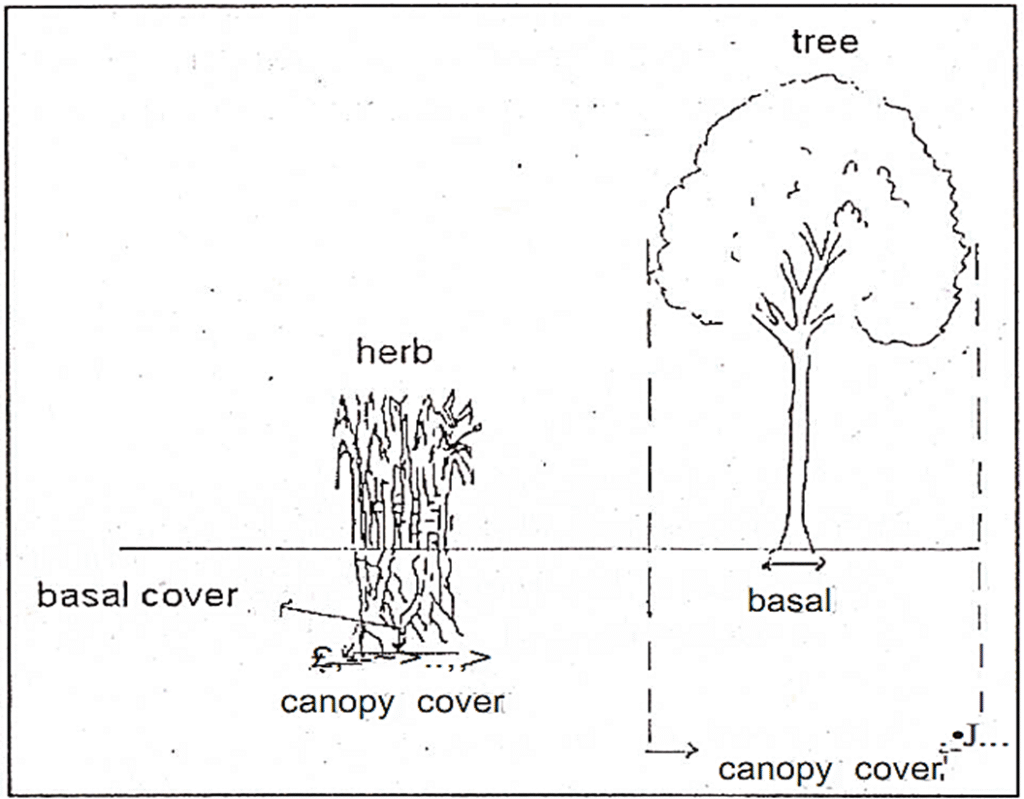
Fig. 9.1: Relationship between Canopy cover and Basal cover
e. Dominance: It describes the influence exerted by a species on a community. The common parameter of dominance is cover, biomass, and productivity. In fact, the number of organisms sometimes may not give correct idea of the species.
•For example, a few large cows have a much greater effect on a grassland than millions of small herbivorous insects. In this instance, the cows will be the dominant species.
•Similarly, in a forest community, big trees are dominant though less numerous as compared to shrubs and herbs, because they monopolize most of the nutrients in the soil and decrease light intensity, increase the relative humidity, intercept the precipitation and furnish shelter and food for the animals.
2. Qualitative Characteristics:
The major qualitative characteristics are as under:
a. Physiognomy: It is the external appearance of vegetation, which may be determined on the basis of dominant plants, density, height, etc.
•For example, a simple look to such a community of plants where larger trees are dominant with some shrubs and herbs would tell us that it is a forest.
•Similarly on the basis of appearance, the terms like grassland, desert, Savana, bogs, etc., describe the physiognomy. of various communities. The physiognomy does not emphasize any particular species or individuals.
c. Stratification: In ecological terminology, the term stratification refers to separation between organisms in space or time.
•An ecosystem can be stratified in space either vertically (in layers) or horizontally (in concentric circles).
•Organisms within ecosystem can also display daily, lunar, or seasonal patterns that separate them in time (i.e. temporal stratification).
•It should not, however, be confused with zonation, which more properly refers to the horizontal or vertical arrangements of biotic or abiotic factors.
Vertical Stratification
•Vertical stratification is usually the result of inter-specific competition for light and water in plants and food in animal.
•Two layers of vertical stratification is commonly recognized:
•An upper stratum of light penetration
•A lower regenerating stratum where organic matter accumulates.
•The upper stratum of light penetration is dominated by autotrophic organisms.
•In a terrestrial ecosystem the upper stratum is often forest vegetation in an aquatic ecosystem it consists of the entire water layer of the sea, lake or pond.
•Decomposers dominate the lower regenerating stratum where organic matter accumulates.
•In terrestrial ecosystem this stratum is soil in aquatic ecosystem it is the sediment.
•Both the upper and lower stratum can further be divided into substrata.
•Vertical distribution (stratification) in a terrestrial ecosystem is best illustrated by reference to a typical forest. The upper stratum has four substrata:
1. The tallest tree (Over story), about 15 meter or more in height, which make up the canopy and receive full sunlight. The foliage of these trees may absorb and scatter more than half of the available light.
2. The shorter trees (Understory), about 6 meter in height, which contain some of the younger individuals of the canopy species as well other species of tall shrubs. These prefer some shade.
3. The shrubs, which receive only 10% of the sunlight after it has filtered down through the over story and understory.
4. The herbs, ferns, mosses (ground layer) which required very little light (usually 1% sunlight) to exist.
•The lower regenerating stratum of forest floor is the soil which also exhibits stratification. The roots may be spread nearer the ground or may be deep penetrating.
•This spacing among the roots permit the plant to draw their water and nutrient requirements from the different layers of the soil without affecting each other.
•The stratification in aerial and underground stratum is shown in Fig 9.2.
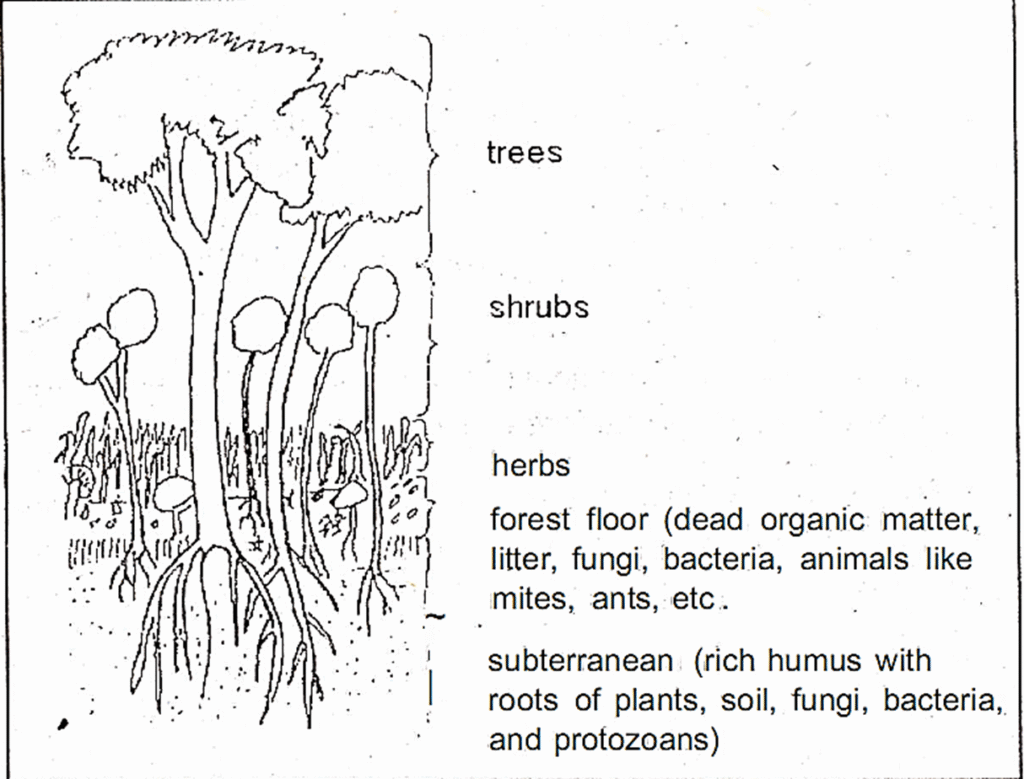
Fig. 9.2: Diagrammatic representation of a forest community showing stratification
•In aquatic ecosystem, ‘such as oceans, lakes, ponds, etc. the stratification is determined by light penetration, temperature and oxygen profiles.
•In the summer, well stratified lakes has a layer of freely circulating surface water,
•the Epilimnion; a second layer,
•the Metalimnion which is characterized by a thermocline (i.e. a very steep and rapid decline in temperature);
•the Hypolimnion, a deep cold layer of dense water about 4 – 5° C, often low in oxygen; and a layer of bottom mud.
Horizontal Stratification
•Horizontal stratification or Dispersion relates to the distribution of organism, principally plants, in the horizontal space (i.e. on the ground) or across the canopy.
•Like vertical stratification, it can influence the presence and absence of certain forms of animal life.
1. Random distribution when each organism appears to be placed without any regard to where another organism occurs; there is no negative or positive interaction between individuals.
2. Clumped or Contagious distribution, when several individuals clumped together in various spots throughout the area. This is the most common pattern of dispersion found in animals and plants.
•For example, ants, bees, termites are grouped in colonies, fish into shoals and humans are clumped together because of social behaviour, economies and geography.
3. Regular or Uniform distribution occur where competition between individual is severe and thus individuals are more or less evenly spaced.
•In animals, such distribution occurs due to some form of intra-specific competition (e.g. birds during breeding season establish and defend territories from other individuals, thus parcelling spaces in a regular way).
•Uniform distribution happens among plants when there is severe competition for crown and root space, as among forest trees, or for moisture, as among desert plants.
Temporal Stratification
•Temporal stratification refers to the more or less rhythmic changes in activities or movements of organisms, which produce regular recurring changes in the complexion of the community as a whole.
•They are synchronized with physical influences such as length of day and night (photoperiodicity), light intensity, humidity, temperature, tides, etc.
•The solar day, lunar day, tidal rhythms, monthly and annual rhythms are common among animal and plants.
b. Phenology: Phenology is the scientific study of life cycle phases of animals or activities of plants in relation to their climate.
•Different species of plants, for example, have different periods of seed germination, vegetation growth, leaf fall, seed dispersal, flowering, fruiting, etc.
•A study of time and date of these events is called phenology. In other words, phenology is the calendar events in the life history of plants and is shown by phenograms (using diagrams and symbols).
d. Life Form: The life form represents the morphological adaptation of organisms to their environment.
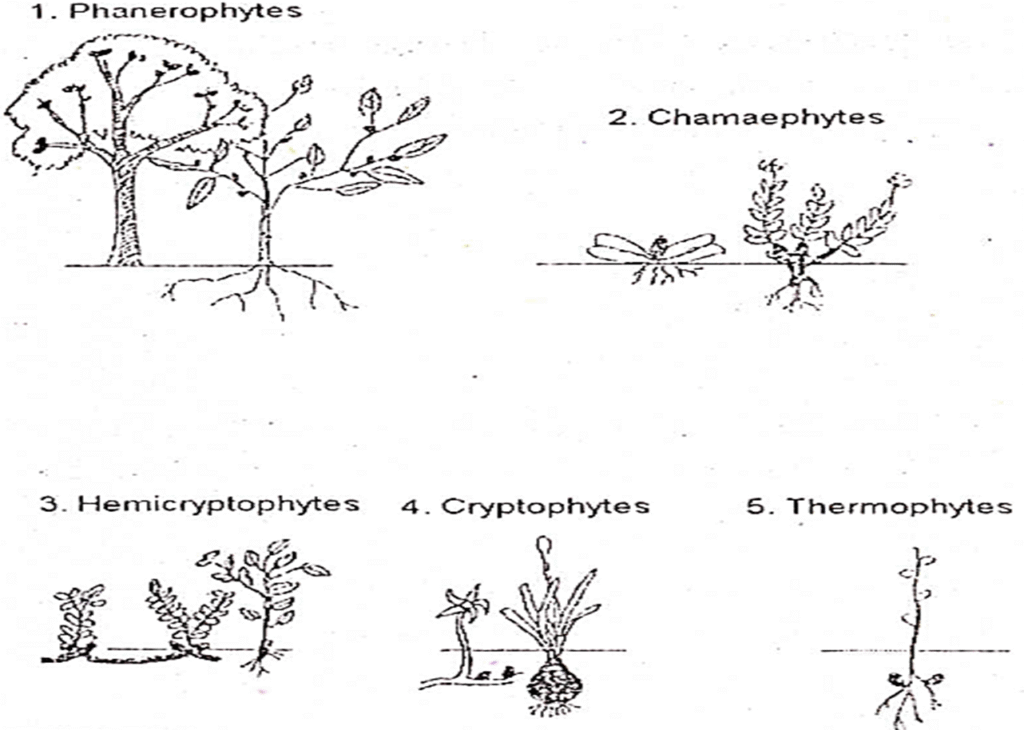
•A number of plant ecologists have attempted to classify land plants according to their form (growth forms as tree, shrubs, herbs, forbs, etc.), habitat or some other characteristics of the various classifications, the one proposed by Rainier (1934) has gained wide recognition and has been extensively followed.
•Rainier classified terrestrial plants into following five categories, on the basis of the position of perennating buds on plant and the degree of protection during adverse conditions (Fig. 9.4).
1. Phanerophytes (visible plants): These have their buds more than 50 cm above from the soil and are usually not protected except that sometimes scales present. They include woody shrubs and trees.
2. Chamaephytes (dwarf plants): These are small shrubs, which have their buds close to the ground surface (less than 25 cm in height).
3. Hemicryptophytes (half-hidden plants): These are plants like herbs and grasses in which buds are just below the soil surface.
4. Cryptophytes (hidden plants): The perennating organs of these plants are well protected under water or soil. This type includes the Geophytes (terrestrial plants with underground tubers, bulb etc.); Helophytes (marsh plants with rhizomes); and Hydrophytes (aquatic plants with buds remaining under water).
5. Therophytes (fine seasonal plants): These plants do not have special perennating organs and pass unfavorable period in the form of seeds. They are mostly annual herbs common in grassland and deserts.
•The major life forms often agree with their taxonomy than do plants. Each major type may again be divided into narrower structural or behavioural types.
•For example, Obsurm et al (1903) classified four footed mammalian forms into the following types:
•1. Aquatic (swimming) —- Seal, Whale, Warlus.
•2. Fossorial (burrowing)—- Mole, Shrews.
•3. Cursorial (running)—- Deer, Horse, Zebra
•4. Saltatorial (leaping) —- Kangaroo, Jumping mice.
•5. Scansorial (climbing) —- Monkey, Squirrel, Bat.
•6. Aerial (flying) —- Bat.
•Vitality: Vitality means the condition of a plant and its capacity to complete the life cycle. Some species are weak and their seeds fail to germinate.
•The health of a species is determined by the weight of a plant, stem height, root length, leaf area, leaf number and number of flowers, fruits, seeds, etc. On this basis, plants are grouped into five vitality groups:
•V1 = plants which germinate but die soon without reproducing.
•V2 = plants which linger after germination but can not reproduce
•V3 = plants reproducing but only vegetation.
•V4 = plants reproducing sexually but rather feebly.
•V5 = plants reproducing well sexually and grow regularly.