
Recording Electrical Potentials from a Partially Depolarized Mass of Syncytial Cardiac Muscles
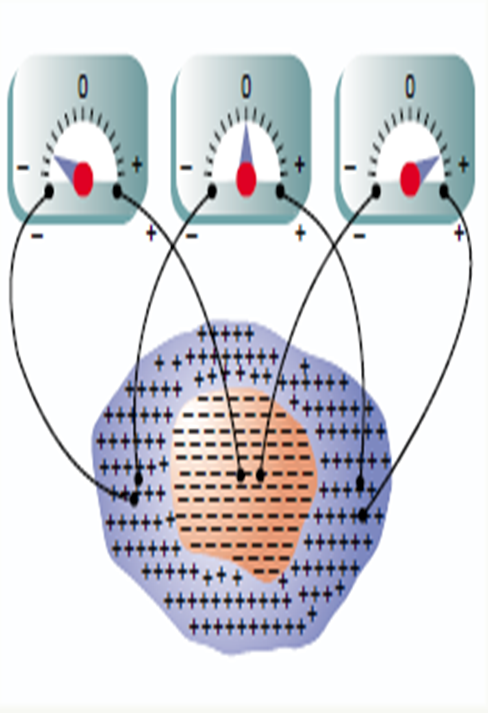
•Depolarized represented by negative charges.
•Polarized represented by positive charges.
•The depolarization spreads in all directions through the heart, the potential differences persist for only a few thousandths of a second.
•The actual voltage measurements can be accomplished only with a high-speed recording apparatus.
•Above figure shows a syncytial mass of cardiac muscle that has been stimulated at its central most point.
•Before stimulation, all the exteriors of the muscle cells had been positive and the interiors negative.
•As soon as an area of cardiac syncytium becomes depolarized, negative charges leak to the outsides of the depolarized muscle fibers, making this part of the surface electronegative.
Flow of Electrical Currents in the Chest Around the Heart
•Figure shows the ventricular muscle lying within the chest.
•When one portion of the ventricles depolarizes and therefore becomes electronegative with respect to the remainder, electrical current flows from the depolarized area to the polarized area in large circuitous routes.
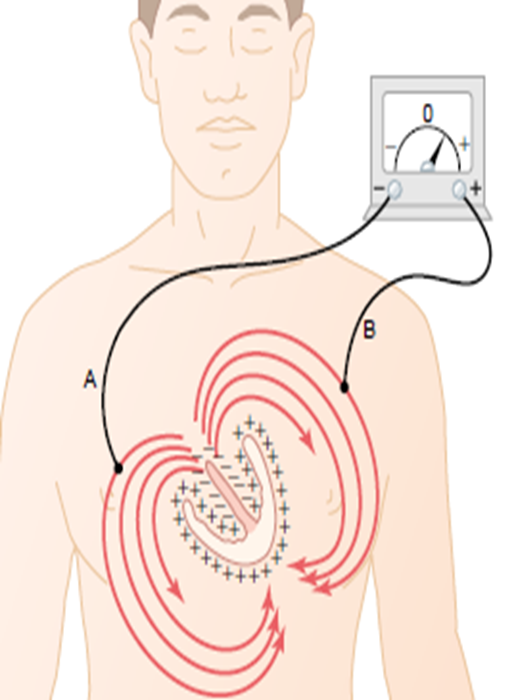
•The cardiac impulse first arrives in the ventricles in the septum and shortly
•Thereafter spreads to the inside surfaces of the remainder of the ventricles,
•as shown by the red areas and the negative signs in Figure.
•Electronegativity on the insides of the ventricles and electropositivity on the outer walls of the ventricles.
•Electrical current flowing through the fluids surrounding the ventricles along elliptical paths.
Electrocardiographic Leads
Three Bipolar Limb Leads
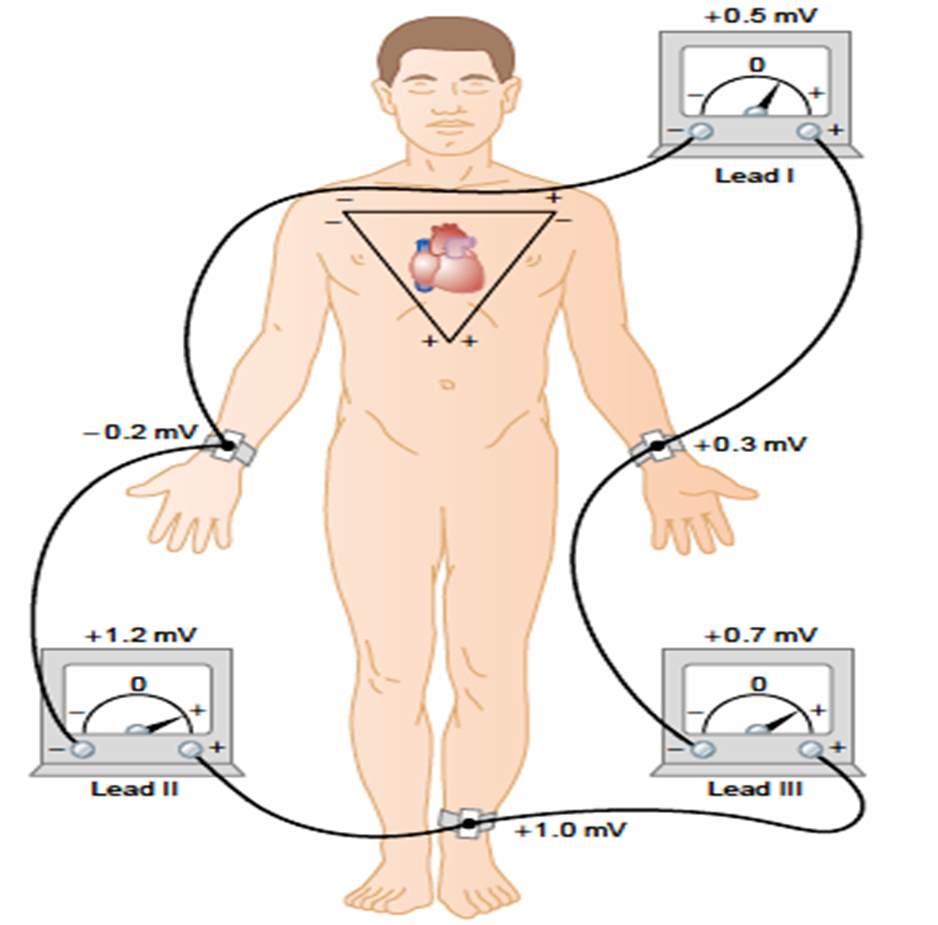
•Electrical connections between the patient’s limbs and the electrocardiograph for recording electrocardiograms from the so-called standard bipolar limb leads.
•The term “bipolar” means that the electrocardiogram is recorded from two electrodes located on different sides of the heart, in this case, on the limbs.
•The electrocardiograph in each instance is represented by an electrical meter in the diagram, although the actual electrocardiograph is a high-speed recording meter with a moving paper.
Lead I.
•In recording limb lead I, the negative terminal of the electrocardiograph is connected to the right arm and the positive terminal to the left arm.
•If the point where the right arm connects to the chest is electronegative with respect to the point where the left arm connects
•The electrocardiograph records positively, above the zero voltage line in the electrocardiogram.
•If the opposite is true, the electrocardiograph records below the line.
Lead II.
To record limb, lead II, the negative terminal of the electrocardiograph is connected to the right arm and the positive terminal to the left leg.
•Therefore, when the right arm is negative with respect to the left leg, the electrocardiograph records positively.
Lead III.
To record limb, lead III, the negative terminal of the electrocardiograph is connected to the left arm and the positive terminal to the left leg.
•This means that the electrocardiograph records positively when the left arm is negative with respect to the left leg.
Einthoven’s Triangle
•In Figure 11–6, the triangle, called Einthoven’s triangle, is drawn around the area of the heart.
•This illustrates that the two arms and the left leg form apices of a triangle surrounding the heart.
•The two apices at the upper part of the triangle represent the points at which the two arms connect electrically with the fluids around the heart, and the lower apex is the point at which the left leg connects with the fluids.
Einthoven’s Law
•Einthoven’s law states that if the electrical potentials of any two of the three bipolar limb electrocardiographic leads are known at any given instant, the third one can be determined mathematically by simply summing the first two.
Normal Electrocardiograms Recorded from the Three Standard Bipolar Limb Leads
•Figure shows recordings of the electrocardiograms in leads I, II, and III. It is obvious that the electrocardiograms in these three leads are similar to one another because they all record positive P waves and positive T waves, and the major portion of the QRS complex is also positive in each electrocardiogram.
•On analysis of the three electrocardiograms, it can be shown, with careful measurements and proper observance of polarities, that at any given instant the sum of the potentials in leads I and III equals the potential in lead II, thus illustrating the validity of Einthoven’s law.

Diagnosis
•Because the recordings from all the bipolar limb leads are similar to one another, it does not matter greatly which lead is recorded when one wants to diagnose different cardiac arrhythmias, because diagnosis of arrhythmias depends mainly on the time relations between the different waves of the cardiac cycle.
•But when one wants to diagnose damage in the ventricular or atrial muscle or in the Purkinje conducting system, it does matter greatly which leads are recorded, because abnormalities of cardiac muscle contraction or cardiac impulse conduction do change the patterns of the electrocardiograms markedly in some leads yet may not affect other leads.
Chest Leads (Precardiac Leads)
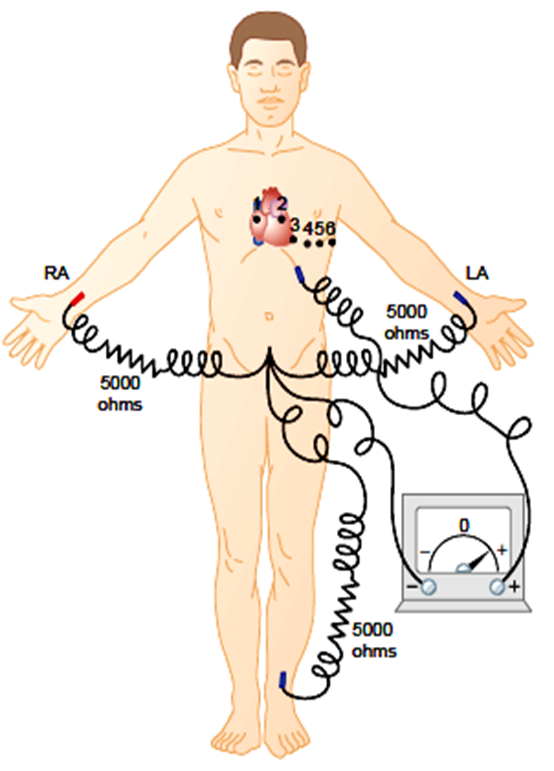
•Often electrocardiograms are recorded with one electrode placed on the anterior surface of the chest directly over the heart at one of the points.
•This electrode is connected to the positive terminal of the electrocardiograph, and the negative electrode, called the indifferent electrode, is connected through equal electrical resistances to the right arm, left arm, and left leg all at the same time, as also shown in the figure.
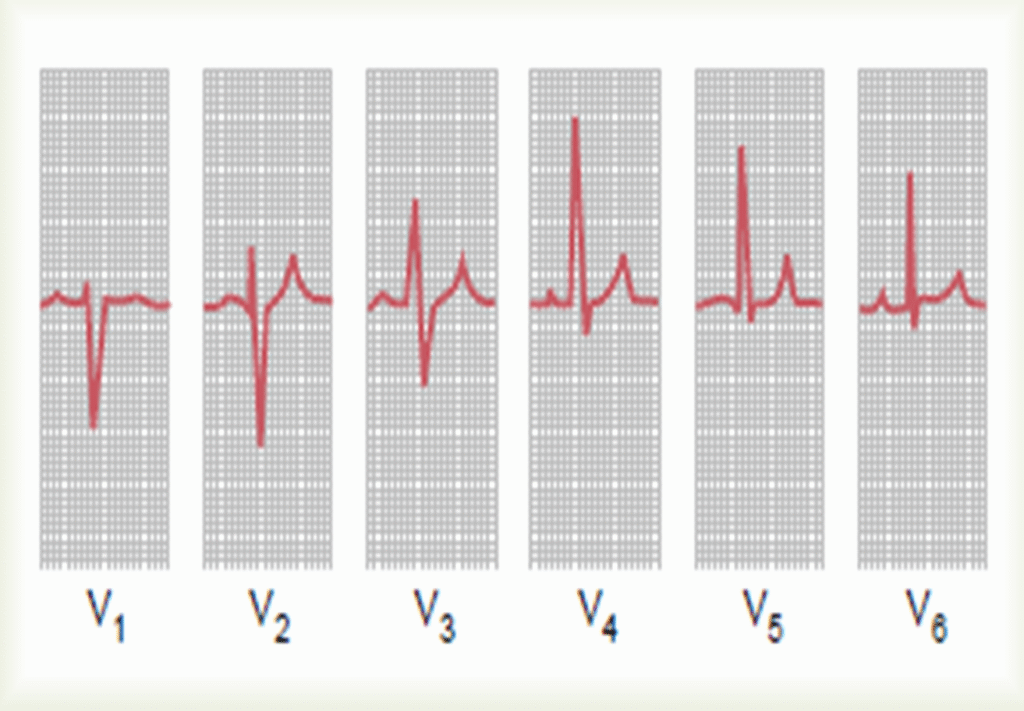
•Usually six standard chest leads are recorded, one at a time, from the anterior chest wall, the chest electrode being placed sequentially at the six points shown in the diagram.
•The different recordings are known as leads V1, V2, V3, V4, V5, and V6.
•In leads V1 and V2, the QRS recordings of the normal heart are mainly negative because, as shown in Figure
•the chest electrode in these leads is nearer to the base of the heart than to the apex, and the base of the heart is the direction of electronegativity during most of the ventricular depolarization process.
•Conversely, the QRS complexes in leads V4, V5, and V6 are mainly positive because the chest electrode in these leads is nearer the heart apex, which is the direction of electro positivity during most of depolarization.
Normal Electrocardiograms Recorded from the Chest Leads
•Figure illustrates the electrocardiograms of the healthy heart as recorded from these six standard chest leads.
•Because the heart surfaces are close to the chest wall, each chest lead records mainly the electrical potential of the cardiac musculature immediately beneath the electrode. Therefore, relatively minute abnormalities in the ventricles, particularly in the anterior ventricular wall, can cause marked changes in the electrocardiograms recorded from individual chest leads.
Augmented Unipolar Limb Leads
•Another system of leads in wide use is the augmented unipolar limb lead.
•In this type of recording, two of the limbs are connected through electrical resistances to the negative terminal of the electrocardiograph and the third limb is connected to the positive terminal.
•When the positive terminal is on the right arm, the lead is known as the aVR lead; when on the left arm, the aVL lead; and when on the left leg, the aVF lead.
Normal electrocardiogram
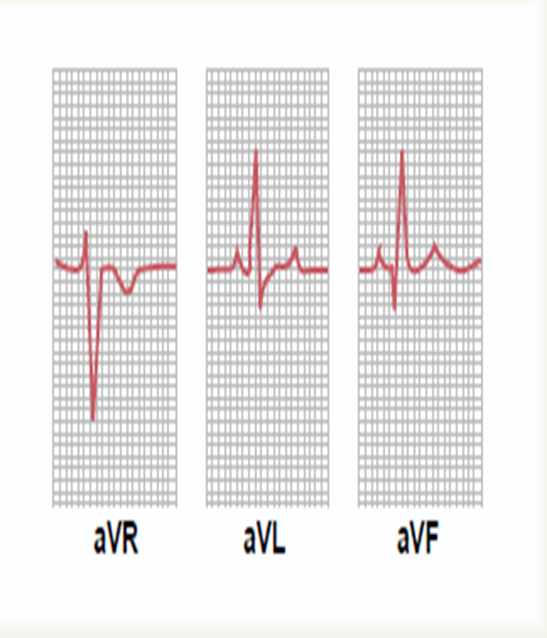
•Normal recordings of the augmented unipolar limb leads. They are all similar to the standard limb lead recordings, except that the recording from the aVR lead is inverted.
Reference
Animal physiology by Eckert,4th edition