
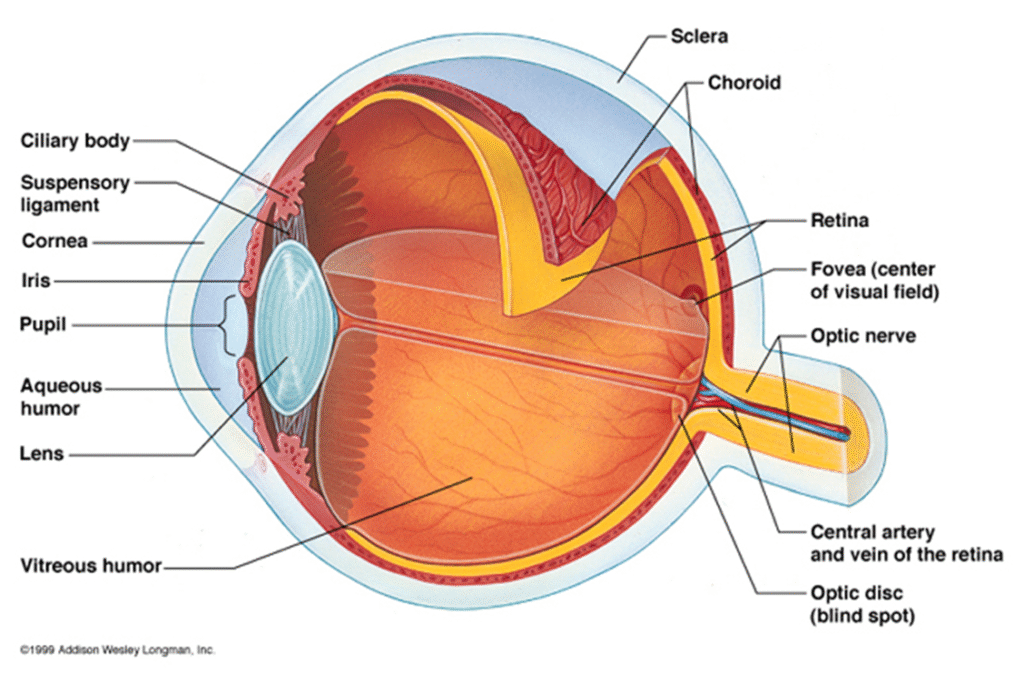
•Photoreceptors located on retina.
•retina contains rods and cones
a) Rods used for black-and-white vision when illumination is dim.
b) Cones are used for color vision, are shorter than rods.
c) Humans have 100 million rods and 3 million cones in each retina.
d) Most cones found in fovea.
(1) Location where eye forms its sharpest image
(2) Almost no rods found here
•Amount of light entering eye controlled by iris.
Sphincter muscle that lies between cornea and lens.
Light passes through pupil, zone in iris.
Enlarges in dim light to allow more light to enter eye.
•Lenses limited by chromatic aberration.
a) Short wavelengths refracted or bent more than longer wavelengths
b) Short wavelengths focus at different point than long wavelengths.
c) Vertebrate eye thus filters out short-wavelength ultraviolet light.
d) Insects do not focus light and can perceive ultraviolet light.
Sense of Vision
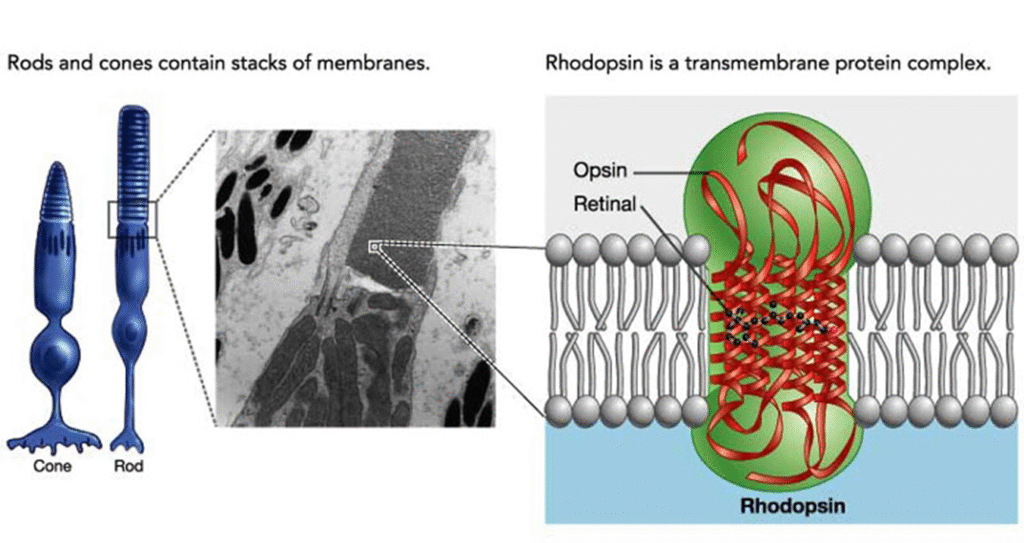
Cellular structure of rods and cones very similar
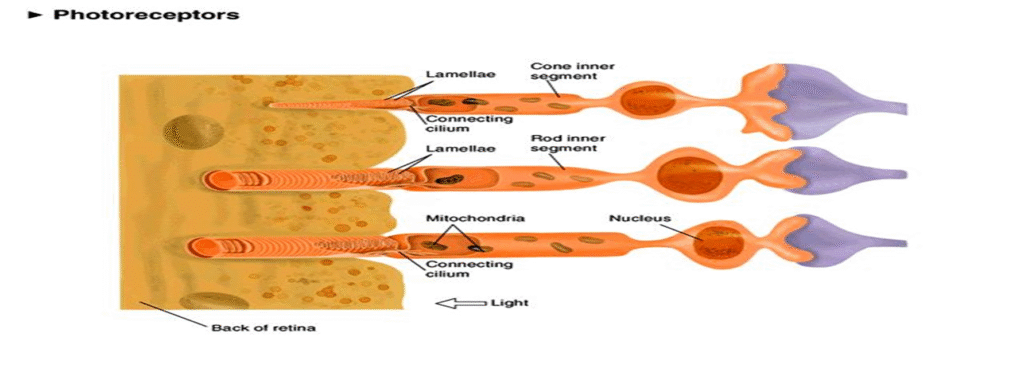
a)Inner segment
(1) Rich in mitochondria
(2) Contains numerous vesicles filled with neurotransmitter molecule
b) Outer segment: connected to inner segment by narrow stalk
(1) Packed with hundreds of flattened disks, stacked on one another
(2) Light-capturing photopigment molecules on membranes of these disks
•Rhodopsin is rod cell photopigment
a) Opsin protein coupled to molecule of cis-retinal.
b) Cis-retinal produced from carotene.
a)Three kinds of cones, each has cis-retinal plus opsin with slightly different amino acid sequence Sequence shifts absorption maximum from 500 nanometers of rhodopsin
(1) 455 nm is blue absorbing.
(2) 530 nm is green absorbing.
(3) 625 nm is red absorbing.
Sensory Transduction in Photoreceptors
Rod or cone contains many Na+ channels in plasma membrane of outer segment.
a) In dark many channels are open.
b) Na+ ions continually diffuse into outer segment, across stalk to inner segment.
c) small flow in absence of light called the dark current.
d) Causes membrane to be somewhat depolarized in the dark.
In the light, Na+ channels in outer segment close rapidly
a) Reduces dark current
b) Causes photoreceptor to hyperpolarize c) Receptor respond by hyperpolarizing rather than depolarizing.
Light causes Na+ channels to close
a) Cis-retinal is converted to trans-retinal when the photopigment absorbs light
b) Isomerization causes retinal to dissociate from opsin: bleaching reaction
c) Opsin protein changes shape
d) Shape change activates G protein
e) In turn activates hundreds of phosphodiester molecules
f) This breaks down intracellular messenger cyclic guanosine monophosphate (cGMP)
Photopigments, G proteins and phosphodiesterase embedded in outer segment disks
a) cGMP found in cytoplasm between disks and plasma membrane
b) cGMP serves as link between events in disk membrane and Na+ channels in plasma membrane
c) cGMP is required to keep channels open
d) When light is absorbed by photopigment, cGMP is broken down
e) Channels close at rate of 1000 per second
f) Each photopigment coupled to many G proteins each to many phosphodiesterases
g) Absorption of one photon cascades to block entry of over a million Na+molecules
h) Photoreceptor thus hyperpolarizes

•In the DARK,
Rhodopsin is inactive (CIS) and cGMP is bound to rod cell membranes; Na channel is open; rod cell is DEPOLARIZED and releases neurotransmitter GLUTAMATE which excites or inhibits adjacent Bipolar cells = no sensation of light.

In the LIGHT
Rhodopsin changes conformation (TRANS), which activated enzyme TRANSDUCIN; transducing activates a PHOSPHODIESTRASE, converts cyclic-GMP to GMP; GMP closes the Na channels, and HYPERPOLARIZES rod cells (RECEPTOR POTENTIAL); hyperpolarized rod cell stops releasing GLUTAMATE, allowing bipolar cells respond.
•Two basic types of photoreceptor, rods and cones, exist in the vertebrate retina.
•The rods are photoreceptors that contain the visual pigment – rhodopsin and are sensitive to blue-green light with a peak sensitivity around 500 nm wavelength of light.
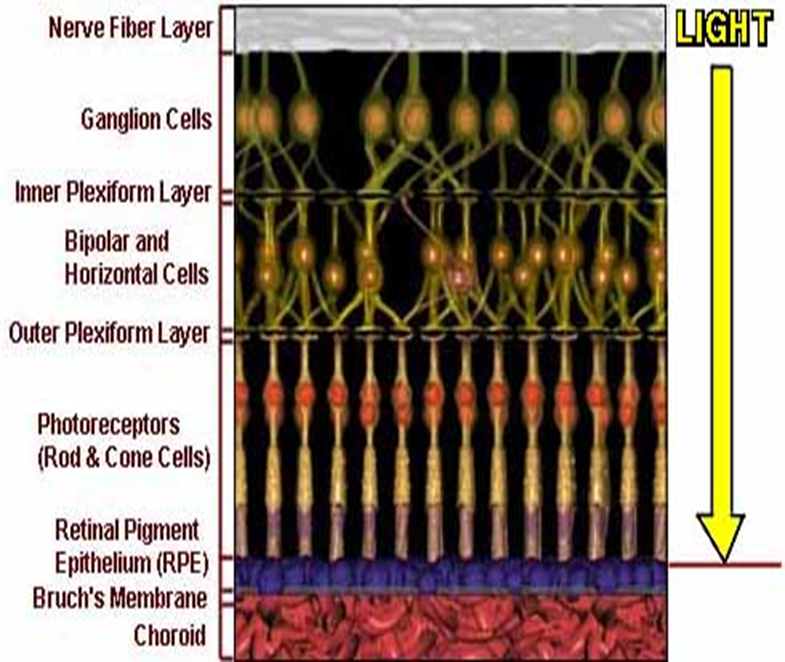
•Rods are highly sensitive photoreceptors and are used for vision under dark-dim conditions at night.
•Cones contain cone opsins as their visual pigments
• and, depending on the exact structure of the opsin molecule, are maximally sensitive to either long wavelengths of light [564nm],medium wavelengths of light [533nm] or short wavelengths of light [437nm].
•Cones of different wavelength sensitivity and the consequent pathways of connectivity to the brain are the basis of color perception in our visual image.
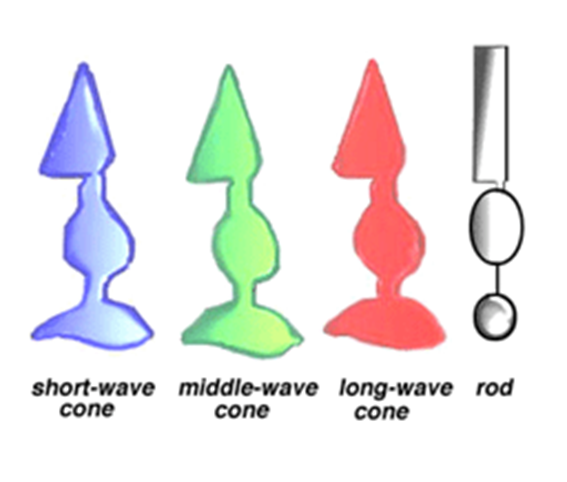
•Three different cone mechanisms can be detected in behavioral, psychophysical and physiological testing.
•These mechanisms are the basis of so-called trichromatic vision which most humans have.
•Where only one or two visual pigment bearing types of cones are present the vision is said to be monochromatic or dichromatic.
•Most mammalian species are dichromatic containing as well as rods only middle and short wavelength sensitive cones in their retinas. Primates and humans, birds, reptiles and fish are trichromatic, tetrachromatic and some even pent achromatic (the latter three vertebrate phyla).
Binocular Vision
1- Visual images of vertebrate eyes
a) Eyes on opposite sides of head, each sees object at different angle
b) Parallax permits sensitive depth perception, stereoscopic vision
2- Predators have eyes set in front of head to increase stereoscopic vision
3- Prey have eyes set on sides of head to enlarge total receptive field.
4- Must learn to perceive distance, not inborn.
References
Animal physiology by Eckert,4th edition