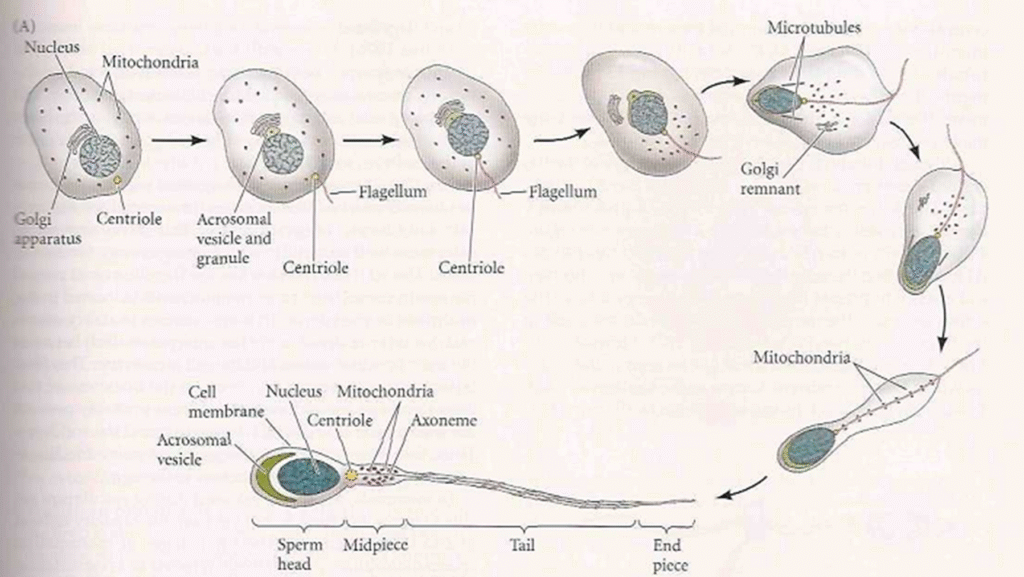
Sperms are male reproductive cells. Each sperm cell consists of a haploid nucleus, a propulsion system to move the nucleus, and a sac of enzymes that enable the nucleus to enter the egg.
In most species, almost all of the cell’s cytoplasm is eliminated during sperm maturation, leaving only certain organelles that are modified for spermatic function.
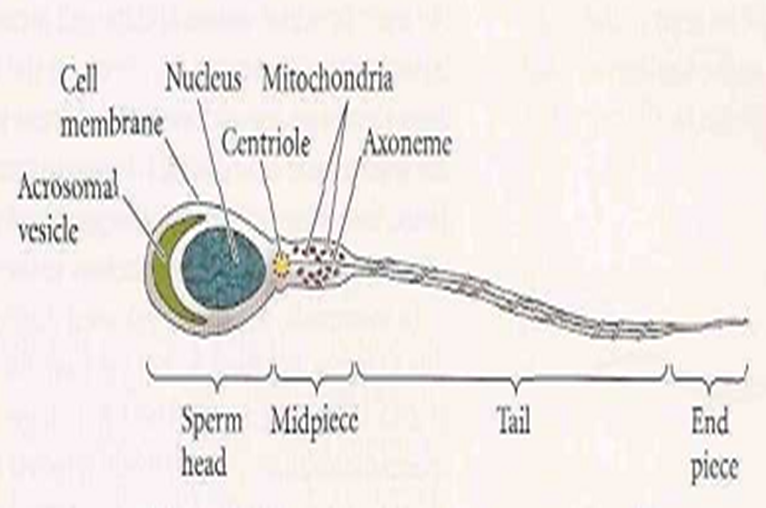
1-Structure of Head of sperm
During the course of maturation, the sperm’s haploid nucleus becomes very streamlined, and its DNA becomes tightly compressed. In front of this compressed haploid nucleus lies the acrosomal vesicle, or acrosome.
The acrosome is derived from Golgi apparatus and contains enzymes that digest proteins and complex sugars; thus, the acrosome can be considered a modified secretory vesicle.
The enzymes stored in the acrosome are used to digest a path through be outer coverings of the egg.
In many species, a region If globular actin proteins lie between the sperm nucleus and the acrosomal vesicle.
These proteins are used to extend a fingerlike acrosomal process from the sperm during the early stages of fertilization.
In sea urchins and several other species, recognition between sperm and egg involves molecules on the acrosomal process.
Together, the acrosome and nucleus constitute the sperm head.
2- Structure of Tail of sperm
In most species (the major exception is, once again, the nematodes, where the sperm is formed at the sites where fertilization occurs), an individual sperm is able to travel by whipping its flagellum.
The major motor portion of the flagellum is the axoneme, a structure formed by microtubules emanating from the centriole at the base of the sperm nucleus.
Axoneme structure 12 The core of the axoneme consists of two central microtubules surrounded by a row of 9 doublet microtubules.
Actually, only one microtubule of each doublet is complete, having 13 protofilaments; the other is C-shaped and has only 11 protofilaments.
The interconnected protofilaments are made exclusively of the dimeric protein tubulin.
Although tubulin is the basis for the structure of the flagellum, other proteins are also critical for flagellar function.
The force for sperm propulsion is provided by dynein, a protein attached to the microtubules.
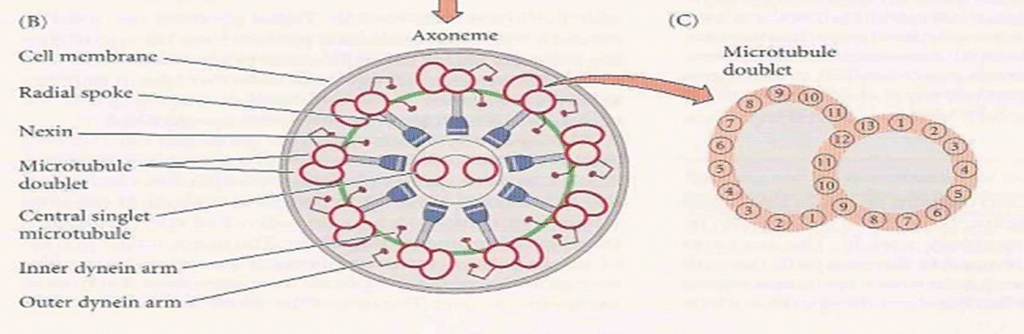
Dynein is an ATPase, an enzyme that hydrolyzes ATP, converting the released chemical energy into mechanical energy to propel the sperm. This energy allows the active sliding of the outer doublet microtubules, causing the flagellum to bend.
3- Mid piece of Sperm
The ATP needed to whip the flagellum and propel the sperm comes from rings of mitochondria located in the midpiece of the sperm.
In many species (notably mammals), a layer of dense fibers has interposed itself between the mitochondrial sheath and the cell membrane. This fibrous layer stiffens the sperm tail. Because the thickness of this layer decreases toward the tip, the fibers probably prevent the sperm head from being whipped around too suddenly.
Thus, the sperm cell has undergone extensive modification for the transport of its nucleus to the egg.
In mammals, the sperm released during ejaculation are able to move, but they do not yet have the capacity to bind to and fertilize an egg.
The final stages of mammalian sperm maturation, cumulatively referred to as capacitation do not occur until the sperm has been inside the female reproductive tract for a certain period of time.