
The Sinus Node as the Pacemaker of the Heart
•In the discussion in last post, thus far of the genesis and transmission of the cardiac impulse through the heart, we have noted that the impulse normally arises in the sinus node.
•In some abnormal conditions, this is not the case. A few other parts of the heart can exhibit intrinsic rhythmical excitation in the same way that the sinus nodal fibers do; this is particularly true of the A-V nodal and Purkinje fibers.
•The A-V nodal fibers, when not stimulated from some outside source, discharge at an intrinsic rhythmical rate of 40 to 60 times per minute, and the Purkinje fibers discharge at a rate somewhere between 15 and 40 times per minute. These rates are in contrast to the normal rate of the sinus node of 70 to 80 times per minute.
Abnormal Pacemakers— “Ectopic” Pacemaker
•Occasionally some other part of the heart develops a rhythmical discharge rate that is more rapid than that of the sinus node.
•For instance, this sometimes occurs in the A-V node or in the Purkinje fibers when one of these becomes abnormal.
•In either case, the pacemaker of the heart shifts from the sinus node to the A-V node or to the excited Purkinje fibers.
•Under rarer conditions, a place in the atrial or ventricular muscle develops excessive excitability and becomes the pacemaker.
•A pacemaker elsewhere than the sinus node is called an “ectopic” pacemaker. Other than original
•An ectopic pacemaker causes an abnormal sequence of contraction of the different parts of the heart and can cause significant debility of heart pumping.
•Another cause of shift of the pacemaker is blockage of transmission of the cardiac impulse from the sinus node to the other parts of the heart.
•The new pacemaker then occurs most frequently at the A-V node or in the penetrating portion of the A-V bundle on the way to the ventricles.
Stokes-Adams syndrome
•When A-V block occurs that is, when the cardiac impulse fails to pass from the atria into the ventricles through the A-V nodal and
•Bundle system the atria continue to beat at the normal rate of rhythm of the sinus node
•A new pacemaker usually develops in the Purkinje system of the ventricles and drives the ventricular muscle at a new rate somewhere between 15 and 40 beats per minute.
•After sudden A-V bundle block, the Purkinje system does not begin to emit its intrinsic rhythmical impulses until 5 to 20 seconds later because, before the blockage, the Purkinje fibers had been “overdriven” by the rapid sinus impulses and, consequently, are in a suppressed state.
•During these 5 to 20 seconds, the ventricles fail to pump blood, and the person faints after the first 4 to 5 seconds because of lack of blood flow to the brain.
•This delayed pickup of the heartbeat is called Stokes-Adams syndrome. If the delay period is too long, it can lead to death.
Role of the Purkinje System in Causing Synchronous Contraction of the Ventricular Muscle
•It is clear from our description of the Purkinje system that normally the cardiac impulse arrives at almost all portions of the ventricles within a narrow span of time, exciting the first ventricular muscle fiber only 0.03 to 0.06 second ahead of excitation of the last ventricular muscle fiber.
•This causes all portions of the ventricular muscle in both ventricles to begin contracting at almost the same time and then to continue contracting for about another 0.3 second.
•The heart is supplied with both sympathetic and parasympathetic nerves.
•The parasympathetic nerves (the vagi) are distributed mainly to the S-A and A-V nodes, to a lesser extent to the muscle of the two atria, and very little directly to the ventricular muscle.
•The sympathetic nerves, conversely, are distributed to all parts of the heart, with strong representation to the ventricular muscle as well as to all the other areas.
Parasympathetic (Vagal) Stimulation Can Slow or Even Block Cardiac Rhythm and Conduction— “Ventricular Escape.”
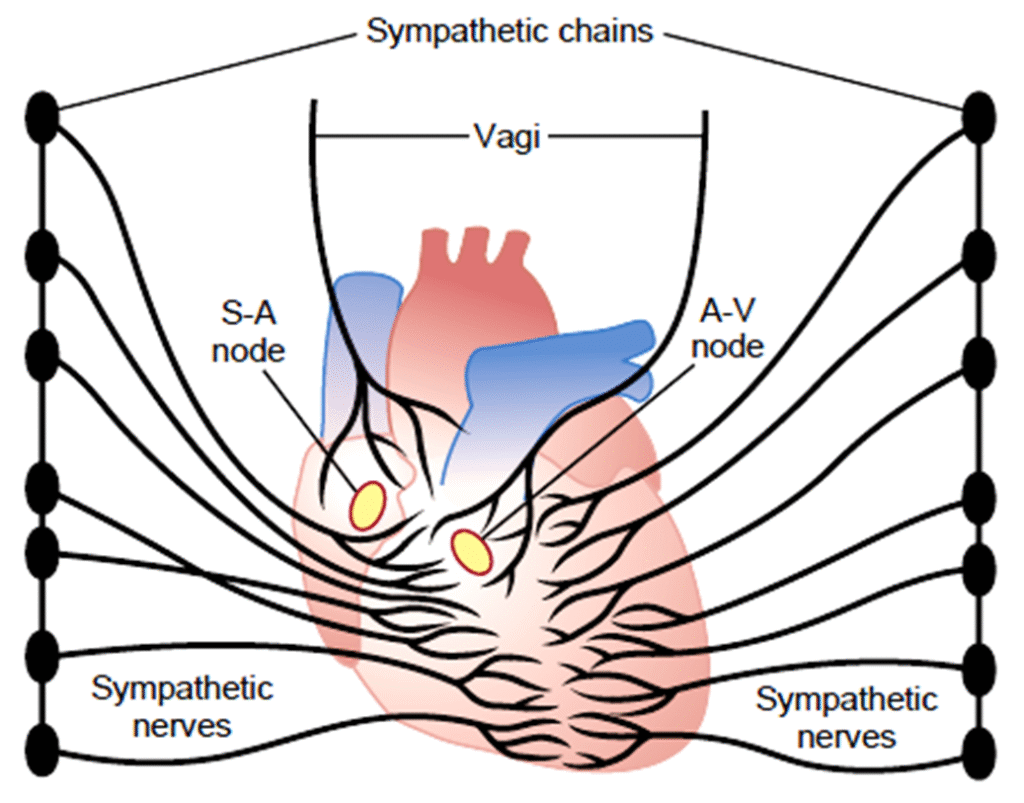
•Stimulation of the parasympathetic nerves to the heart (the vagi) causes the hormone acetylcholine to be released at the vagal endings.
•This hormone has two major effects on the heart.
•First, it decreases the rate of rhythm of the sinus node, and second, it decreases the excitability of the A-V junctional fibers between the atrial musculature and the A-V node, thereby slowing transmission of the cardiac impulse into the ventricles.
•Weak to moderate vagal stimulation slows the rate of heart pumping, often to as little as one half normal.
•And strong stimulation of the Vagi can stop completely the rhythmical excitation by the sinus node or block completely transmission of the cardiac impulse from the atria into the ventricles through the A-V mode.
References
Animal physiology by Eckert, 4th edition