Introduction
•Exotic and invasive species are two types of non-native species. Non-native species can be found in a second ecosystem apart from the ecosystem they evolved from.
•Non-native species spread by natural process or human activities. Most non-native or indigenous species are harmless. They are called exotic species.
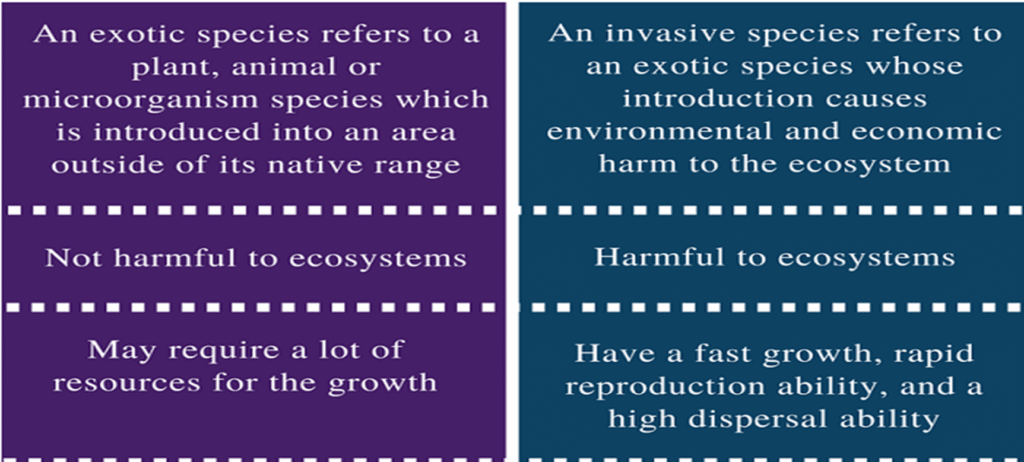
•When an exotic species becomes harmful to the ecosystem, it is called an invasive species. The main difference between exotic and invasive species is that exotic species is harmless to the ecosystem whereas invasive species is harmful to the ecosystem. Invasive species can be harmful the native habitats, natural areas such as lakes, forests, and rivers, agriculture, economy, and humans.
Difference Between Exotic and Invasive Species
What is an Exotic Species?
•An exotic species refers to a plant, animal or microorganism species, which is introduced into an area where it does not occur naturally.
•Plants are introduced into new ecosystems in both agriculture and horticulture. In addition, settlers bring seeds of plants from their homelands due to the economic or medicinal properties of those plants. Most of these exotic plants do not flourish in the wild.
•But some plants get adapted to the environmental and climate changes and reproduce to invade the wild areas as well.
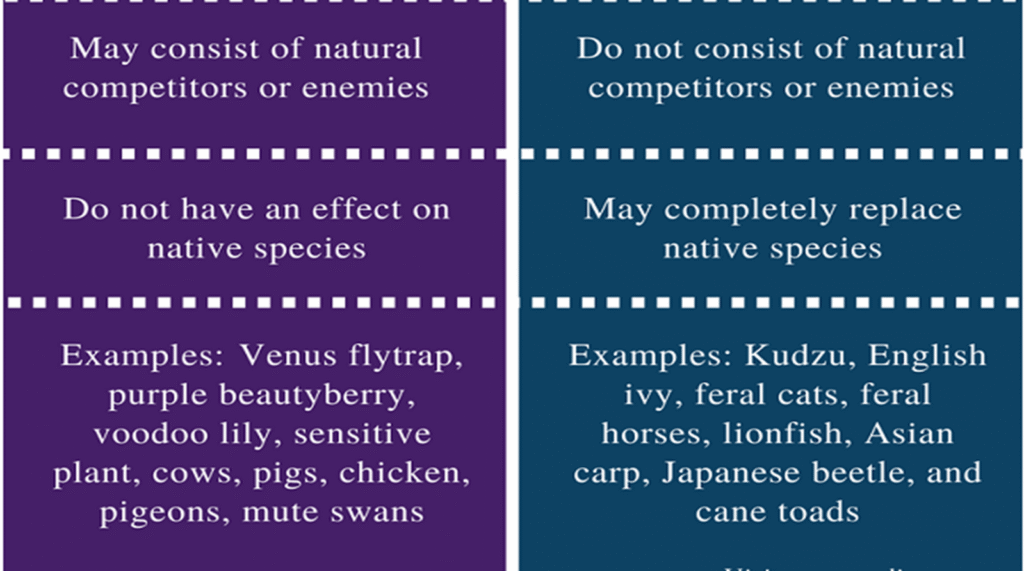
•The Venus flytrap (Dionaea muscipula), purple beautyberry (Callicarpa dichotoma), voodoo lily (Amorphophallus spp.), Sensitive Plant (Mimosa pudica), Cycad (Encephalartos woodie), Flypaper Plant (Pinguicula gigantea), Corpse Flower (Amorphophallus titanium), and Dancing Plant (Desmodium Gyra’s) are some examples of exotic plants. Sensitive plant is shown in figure 1
•As mentioned above, exotic species can also include animals. Exotic animals such as cows, pigs, chicken, pigeons, mute swans, cats, dogs, and horses are mostly domesticated. These animals can also become feral. The native plants are endangered by those feral exotic animals.
What is an Invasive Species?
•An invasive Species refers to an exotic species whose introduction causes environmental and economic harm to the ecosystem.
•This means a significant modifications or disruptions may be caused to ecosystem by an invasive species. The arrival of the invasive species may occur by natural processes.
•But, most of these species are introduced to the ecosystems by humans. Invasive species consists of characteristics such as fast growth, rapid reproduction, high dispersal ability, phenotypic plasticity, and ecological competence.
•Therefore, these species compete with the native species for food and other resources in the introduced ecosystem.
•They also cause diseases to the native species. Both invasive plants and animals consume native species for food.
•Kadzu (pueraria montana var lobata) is an invasive plant in the USA, which covers millions of arches of land.
•Purple loosestrife (Ly thrum salicornia), Japanese honeysuckle (lonicera japonica) and English ivy (hedera helix) are other examples of invasive plants. Kudzu is shown in figure 2.
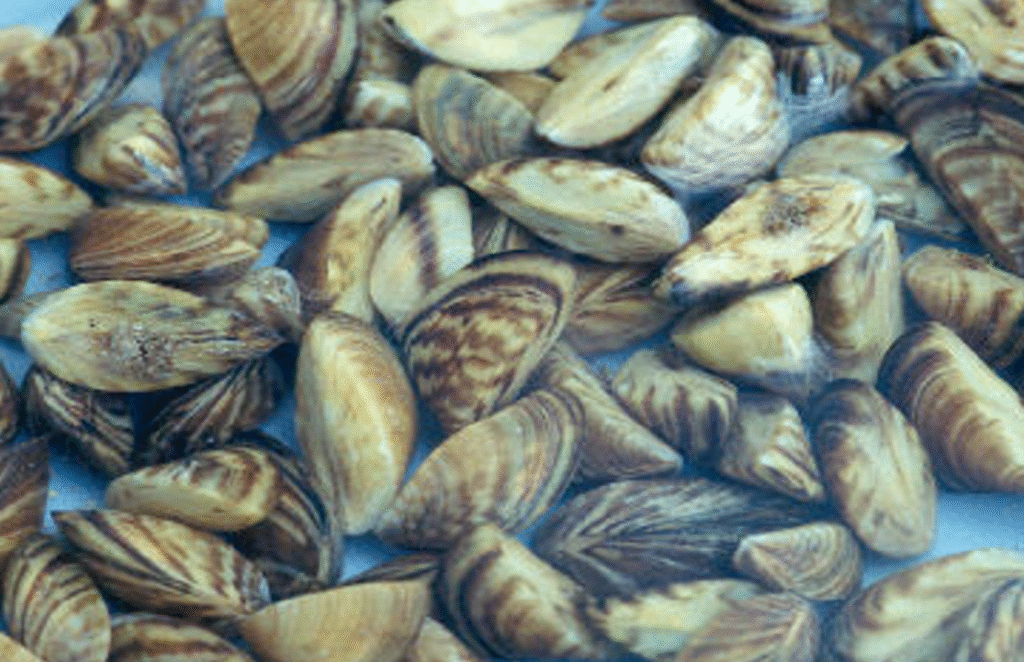
•Zebra mussel is an introduced species to the bilge water. Zebra mussels are shown in figure 3. But these mussels are now colonized and compete for zooplankton with native animals.
•They also become problematic in lakes and rivers since they clog up the waterways.
•House mice, feral cats, feral horses, lionfish, Asian carp, Japanese beetle, and cane toads are some examples of invasive animals.
Causes
•Scientists include species and ecosystem factors among the mechanisms that, when combined, establish invasiveness in a newly introduced species.
•Species based mechanisms
•While all species compete to survive, invasive species appear to have specific traits or specific combinations of traits that allow them to outcompete native species. In some cases, the competition is about rates of growth and reproduction. In other cases, species interact with each other more directly.
•Researchers disagree about the usefulness of traits as invasiveness markers. One study found that of a list of invasive and non- invasive species, 86% of the invasive species could be identified from the traits alone. Another study found invasive species tended to have only a small subset of the presumed traits and that many similar traits were found in non-invasive species, requiring other explanations.
••Common invasive species traits include the following:
•Fast growth
•Rapid reproduction
•High dispersal ability
•Phenotype plasticity (the ability to alter growth form to suit current conditions)
•Tolerance of a wide range of environmental conditions (Ecological competence)
•Ability to live off of a wide range of food types (generalist)
•Association with humans
•Prior successful invasions
•Typically, an introduced species must survive at low population densities before it becomes invasive in a new location.
•At low population densities, it can be difficult for the introduced species to reproduce and maintain itself in a new location, so a species might reach a location multiple times before it becomes established. Repeated patterns of human movement, such as ships sailing to and from ports or cars driving up and down highways offer repeated opportunities for establishment (also known as a high propagule pressure).
•An introduced species might become invasive if it can outcompete native species for resources such as nutrients, light, physical space, water, or food.
•If these species evolved under great competition or predation, then the new environment may host fewer able competitors, allowing the invader to proliferate quickly.
•Ecosystems which are being used to their fullest capacity by native species can be modeled as zero-sum systems in which any gain for the invader is a loss for the native.
•However, such unilateral competitive superiority (and extinction of native species with increased populations of the invader) is not the rule.
•Invasive species often coexist with native species for an extended time, and gradually, the superior competitive ability of an invasive species becomes apparent as its population grows larger and denser, and it adapts to its new location.
Ecosystem-based mechanisms
•In ecosystems, the amount of available resources and the extent to which those resources are used by organisms determines the effects of additional species on the ecosystem. In stable ecosystems, equilibrium exists in the use of available resources. These mechanisms describe a situation in which the ecosystem has suffered a disturbance, which changes the fundamental nature of the ecosystem.
•When changes such as a forest fire occur, normal succession favors native grasses and forbs. An introduced species that can spread faster than natives can use resources that would have been available to native species, squeezing them out. Nitrogen and phosphorus are often the limiting factors in these situations.
•Every species occupies a niche in its native ecosystem; some species fill large and varied roles, while others are highly specialized. Some invading species fill niches that are not used by native species, and they also can create new niches. An example of this type can be found within the Lampropholis delicata species of skink.
•Ecosystem changes can alter species’ distributions. For example, edge effects describe what happens when part of an ecosystem is disturbed as when land is cleared for agriculture.
•The boundary between remaining undisturbed habitat and the newly cleared land itself forms a distinct habitat, creating new winners and losers and possibly hosting species that would not thrive outside the boundary habitat.
•Rapid adaptive evolution in these species leads to offspring that have higher fitness and are better suited for their environment. Intraspecific phenotypic plasticity, pre-adaptation and post-introduction evolution are all major factors in adaptive evolution.
•Plasticity in populations allows room for changes to better suit the individual in its environment. This is key in adaptive evolution because the main goal is how to best be suited to the ecosystem that the species has been introduced.
•The ability to accomplish this as quickly as possible will lead to a population with a very high fitness. Pre-adaptations and evolution after the initial introduction also play a role in the success of the introduced species.
•If the species has adapted to a similar ecosystem or contains traits that happen to be well suited to the area that it is introduced, it is more likely to fare better in the new environment.
•This, in addition to evolution that takes place after introduction, all determine if the species will be able to become established in the new ecosystem and if it will reproduce and thrive.
Effects of invasive species
•Ecological
•Land clearing and human habitation put significant pressure on local species.
•Disturbed habitats are prone to invasions that can have adverse effects on local ecosystems, changing ecosystem functions.
•A species of wetland plant known as Aiea in Hawaii (the indigenous Bacopa Manieri) is regarded as a pest species in artificially manipulated water bird refuges because it quickly covers shallow mudflats established for endangered Hawaiian stilt (Himantopus mexicanus Knudsen), making these undesirable feeding areas for the birds.
•Invasive species can change the functions of ecosystems.
•For example, invasive plants can alter the fire regime, nutrient cycling, and hydrology in native ecosystems.
•Invasive species that are closely related to rare native species have the potential to hybridize with the native species.
•Harmful effects of hybridization have led to a decline and even extinction of native species.
•For example, hybridization with introduced cordgrass, Spartina alterniflora, threatens the existence of California cordgrass (Spartina foliose) in San Francisco Bay. Invasive species cause competition for native species and because of this 400 of the 958 endangered species under the Endangered Species Act are at risk.
•Geomorphological
•Primary geomorphological effects of invasive plants are bioconstruction and bioprotection.
•For example, Kudzu Pueraria Montana, a vine native to Asia was widely introduced in the southeastern USA in the early 20th century to control soil erosion.
•While primary effects of invasive animals are bioturbation, bioerosion, and bioconstruction.
•For example, invasion of Chinese mitten crab Ericeira sinensis have resulted in higher bioturbation and bioerosion rates.
•Economic
•Some invaders cause negative benefits towards the economy of the local area. For example, in the Great Lakes Region the sea lamprey is an invasive species that acts as a predator. In its original habitat, the sea lamprey used co-evolution to act as a parasite without killing the host organism.
•However, in the Great Lakes Region, this co-evolutionary link is nonexistent, so the sea lamprey acts as a predator, and can consume up to 40 pounds of fish in its 12-18 month feeding period.
•Sea lampreys’ prey on all types of large fish such as lake trout and salmon. The sea lampreys’ destructive effects towards large fish negatively affects the fishing industry and has helped collapse the population of some economy dependent species.
•Benefits of invasive species
•Although most people focus on the negative effects of invasive and non-native species, they can actually be harmless or even beneficial in some cases. Ecosystems thrive because of biodiversity and some need non-native species in order to succeed.
•There are four major ways that non-natives can be very beneficial for an ecosystem.
•1 The first is that they can provide a suitable habitat or food source for other organisms.
•In areas where a native has become extinct or reached a point that it cannot be restored, non-native species can fill their role.
•2The second way that non-native species can be beneficial is that they act as catalysts for restoration. This is because the presence of non-native species increases the heterogeneity and biodiversity in an ecosystem. This increase in heterogeneity can create microclimates in sparse and eroded ecosystems, which then promotes the growth and reestablishment of native species.
3 Another benefit of non-native species is that they can act as a substitute for an existing ecosystem engineer. In many cases, non-native species can be introduced to fill a niche that had previously been occupied by a native species.
•4 The last benefit of non-native species is that they provided ecosystem services. There are many examples of this. The major one being pollinators.
•Health
•Encroachment of humans into previously remote ecosystems has exposed exotic diseases such as HIV to the wider population. Introduced birds (e.g. pigeons), rodents and insects (e.g. mosquito, flea, louse and tsetse fly pests) can serve as vectors and reservoirs of human afflictions. Throughout recorded history, epidemics of human diseases, such as malaria, yellow fever, typhus, and bubonic plague, spread via these vectors.
•A recent example of an introduced disease is the spread of the West Nile virus, which killed humans, birds, mammals, and reptiles.
•The introduced Chinese mitten crabs are carriers of Asian lung fluke.
•Waterborne disease agents, such as cholera bacteria (Vibrio cholerae), and causative agents of harmful algal blooms are often transported via ballast water.
•Invasive species and accompanying control efforts can have long term public health implications. For instance, pesticides applied to treat a particular pest species could pollute soil and surface water.
•Biodiversity
•Biotic invasion is considered one of the five top drivers for global biodiversity loss and is increasing because of tourism and globalization. This may be particularly true in inadequately regulated fresh water systems, though quarantines and ballast water rules have improved the situation.
•Invasive species may drive local native species to extinction via competitive exclusion, niche displacement, or hybridization with related native species. Therefore, besides their economic ramifications, alien invasions may result in extensive changes in the structure, composition and global distribution of the biota of sites of introduction, leading ultimately to the homogenization of the world’s fauna and flora and the loss of biodiversity.
•Nevertheless, it is difficult to unequivocally attribute extinctions to a species invasion, and the few scientific studies that have done so have been with animal taxa. Concern over the impacts of invasive species on biodiversity must therefore consider the actual evidence (either ecological or economic), in relation to the potential risk.
•Genetic pollution
•Native species can be threatened with extinction through the process of genetic pollution.
•Genetic pollution is unintentional hybridization and introgression, which leads to homogenization or replacement of local genotypes as a result of either a numerical or fitness advantage of the introduced species.
•Genetic pollution occurs either through introduction or through habitat modification, where previously isolated species are brought into contact with the new genotypes. Invading species have been shown to adapt to their new environments in a remarkably short amount of time.
•The population size of invading species may remain small for a number of years and then experience an explosion in population, a phenomenon known as “the lag effect”