Fertilization is the process whereby the sperm and the egg—collectively called the gametes—fuse together to begin the creation of a new individual whose genome is derived from both parents.
Fertilization accomplishes two separate ends: sex (the combining of genes derived from two parents) and reproduction (the generation of a new organism).
Thus, the first function of fertilization is to transmit genes from parent to offspring, and the second is to initiate in the egg cytoplasm those reactions that permit development to proceed.
Events of Fertilization
Although the details of fertilization vary from species to species, conception generally consists of four major events.
1- Contact and recognition between sperm and egg.
2- Regulation of sperm entry into the egg. Only one sperm nucleus can unite with egg nucleus.
3- Fusion of the genetic material of sperm and egg.
4- Activation of egg metabolism to start development.
Recognition of Egg and Sperm
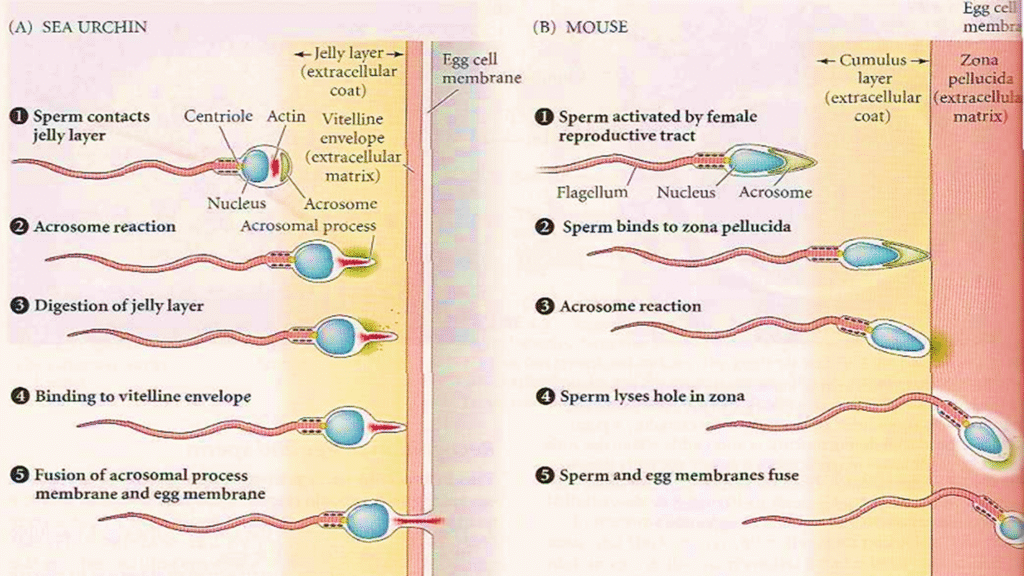
The interaction of sperm and egg generally proceeds according to five basic steps.
1-The chemoattraction of the sperm to the egg by soluble molecules secreted by the egg.
2- The exocytosis of the sperm acrosomal vesicle to release its enzymes.
3- The binding of the sperm to the extracellular matrix of the egg.
4- The passage of the sperm through the extracellular matrix.
5- Fusion of egg and sperm cell membranes.
The interaction of sperm and egg shown in picture below.
Sperm attraction- Action at a distance
Species specific sperm attraction has been documented in numerous species, including cnidarians, echinoderms, amphibians, and urochordates.
In many species, sperm are attracted toward eggs of their species by chemotaxis that is, by following a gradient of a chemical secreted by the egg.
Examples
1- Cnidarian Ortho pyxis claviculate not only secrete a chemotactic factor but also regulate the timing of its release.
When sperm were added to oocytes that had not yet completed their second meiotic division, there was no attraction of sperm to eggs.
However, after the second meiotic division was finished and the eggs were ready to be fertilized, the sperm migrated toward them.
2- In sea urchin, sperm motility is acquired when the sperm are spawned into sea water. As long as sperm cells are in the testes, they cannot move because their internal pH is kept low at 7.2 by the high concentrations of CO, in the gonad.
However, once spawned into seawater, sperm pH is elevated to about 7.6 resulting in the activation of the dynein ATPase.
The splitting of ATP provides the energy for flagella to wave, and the sperm begin swimming vigorously. But the ability to move does not provide the sperm with direction.
In echinoderms, direction is provided by small chemotactic peptides such as Resact.Resact is a 14-amino acid peptide that has been isolated from the egg jelly of sea urchin Arbacia punctulata.
Resact diffuses readily from egg jelly into the seawater and has a profound effect at very low concentrations when added to a suspension of Arbacia sperm.
When a drop of seawater containing Arbacia sperm is placed on a microscope slide, the sperm generally swim in circles about 50 urns in diameter.
In addition to its function as a sperm-attracting peptide, resact also acts as a Sperm-activating peptide.
One of the major roles of the egg jelly is to increase the motility of sperm, and sperm- activating peptides cause dramatic and immediate increase in mitochondrial respiration and sperm motility.
The increases in cyclic GMP and ca2+ also activate the mitochondrial ATP-generating apparatus and the dynein ATPase that stimulates flagellar movement in the sperm.
So, upon meeting resact ,Arbacia sperm are instructed where to go and are given the motive force to get there.