Introduction
Metamorphosis is the complete change of structures in larvae or egg form of organisms into an adult form regulated by many factors such as hormones.
•In most animal species, however, embryonic development includes a larval stage with characteristics very different from those of the adult organism, which emerges only after a period of metamorphosis; these animals are indirect developers.
•Very often, larval forms are specialized for some function such as growth or dispersal, while the adult is specialized for reproduction. Cecropia moths, for example, hatch from eggs and develop as wingless juveniles—caterpillars—for several months.
•After metamorphosis, the insects spend a day or so as fully developed winged moths and must mate quickly before they die.
•The adults never eat, and in fact have no mouth parts during this brief reproductive phase of the life cycle.
•As might be expected, the juvenile and adult forms often live in different environments. During metamorphosis, developmental processes are reactivated by specific hormones, and the entire organism changes morphologically, physiologically, and behaviorally to prepare itself for its new mode of existence.
Amphibian Metamorphosis
•Amphibians are named for their ability to undergo metamorphosis, their appellation coming from the Greek amphi (“double”) and bios (“life”).
•Amphibian metamorphosis is associated with morphological changes that prepare an aquatic organism for a primarily terrestrial existence.
•In urodeles (salamanders), these changes include the resorption of the tail fin, the destruction of the external gills, and a change in skin structure.
•In anurans (frogs and toads), the metamorphic changes are more dramatic, with almost every organ subject to modification.
•The changes in amphibian metamorphosis are initiated by thyroid hormones such as thyroxine (T4) and triiodothyronine (T3) that travel through the blood to reach all the organs of the larva.
•When the larval organs encounter these thyroid hormones, they can respond in any of four ways: growth, death, remodeling, and respecification.
Detail Process of Amphibian Metamorphosis
1-Morphological changes
1- GROWTH OF NEW STRUCTURES
•The hormone triiodothyronine induces certain adult-specific organs to form.
•The limbs of the adult frog emerge from specific sites on the metamorphosing tadpole, and in the eye, both nictitating membranes and eyelids emerge.
•Moreover, T3 induces the proliferation and differentiation of new neurons to serve these organs. As the limbs grow out from the body axis, new neurons proliferate and differentiate in the spinal cord.
•These neurons send axons to the newly formed limb musculature.
•Blocking T3 activity prevents these neurons from forming and causes paralysis of the limbs.
•One readily observed consequence of anuran metamorphosis is the movement of the eyes to the front of the head from their originally lateral position.
•The lateral eyes of the tadpole are typical of preyed-upon herbivores, whereas the frontally located eyes of the frog befit its more predatory lifestyle. To catch its prey, the frog needs to see in three dimensions. That is, it has to acquire a binocular field of vision, where inputs from both eyes converge in the brain
•In the tadpole, the right eye innervates the left side of the brain, and vice versa; there are no ipsilateral (same-side) projections of the retinal neurons.
•During metamorphosis, however, ipsilateral path-ways emerge, enabling input from both eyes to reach the same area of the brain.
•In Xenopus, these new neuronal pathways result not from the remodeling of existing neurons, but from the formation of new neurons that differentiate in response to thyroid hormones. The ability of these axons to project ipsilateral results from the induction of ephrin B in the optic chiasm by the thyroid hormones
•Ephrin’s B is also found in the optic chiasm of mammals (which have ipsilateral projections throughout life) but not in the chiasm of fish and birds (which have only contralateral projections). Ephrin’s can repel certain neurons, causing them to project in one direction rather than in another.
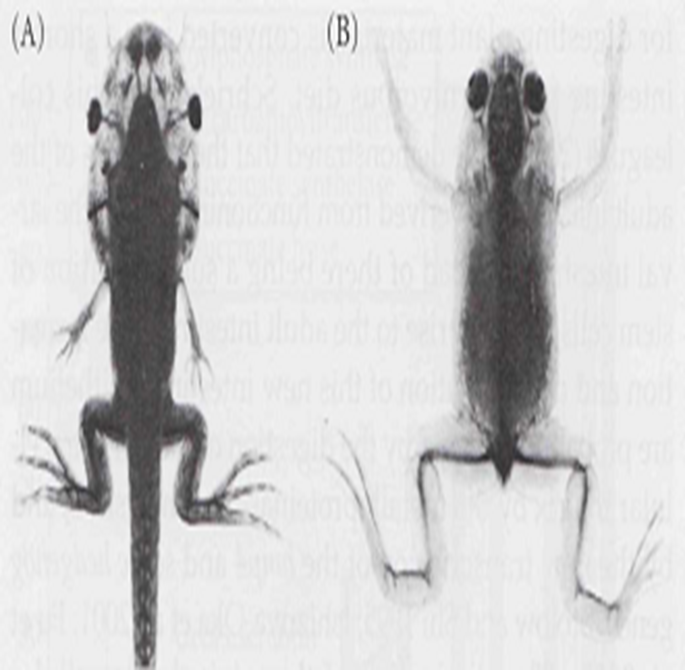
•Eye migration and associated neuronal changes during metamorphosis of the Xenopus laevis tadpole.
•(A) The eyes of the tadpole are laterally placed, so there is relatively little binocular field of vision.
•(B) The eyes migrate dorsally and rostrally during metamorphosis, creating a large binocular field for the adult frog.
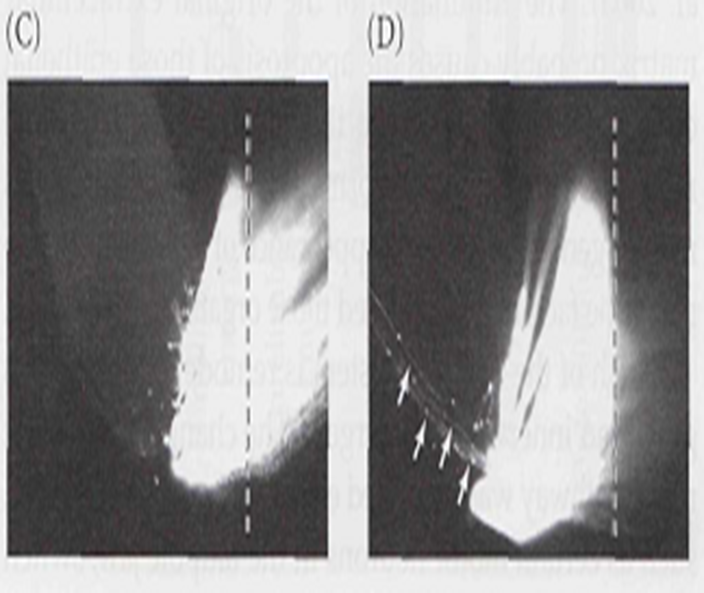
•.(C) In early and middle stages of metamorphosis, axons project across the midline (dashed line) from one side of the brain to the other.
•(D) In late metamorphosis, ephrin’s B is produced in the optic chiasm as certain neurons (arrows) are formed that project ipsilaterally.
2•CELL DEATH DURING METAMORPHOSIS
•The hormone T3 also induces certain larval-specific structures to die.
•Thus, T3 causes the degeneration of the paddle-like tail and the oxygen procuring gills that were important for larval (but not adult) movement and respiration.
•Recent evidence suggests that the first part of tail resorption is caused by suicide, but that the last remnants of the tadpole tail must be killed off by other means.
•When tadpole muscle cells were injected with a dominant negative T3 receptor (and therefore could not respond to T3), the muscle cells survived, indicating that T3 told them to kill themselves by apoptosis.
•This was confirmed by the demonstration that the apoptosis-inducing enzyme caspase-9 is important in causing cell death in the tadpole muscle cells.
•However, later in metamorphosis, the tail muscles are destroyed by phagocytosis, perhaps because the extracellular matrix that supported the muscle cells has been digested by proteases.
•Death also comes to the tadpole’s red blood cells. During metamorphosis, tadpole hemoglobin is changed into adult hemoglobin, which binds oxygen more slowly and releases it more rapidly.
•The red blood cells carrying the tadpole hemoglobin have a different shape than the adult red blood cells, and these larval red blood cells are specifically digested eaten by macrophages in the liver and spleen.
3•REMODELING DURING METAMORPHOSIS
•Among frogs and toads, certain larval structures are remodeled for adult needs.
•Thus, the larval intestine, with its numerous coils for digesting plant material, is converted into a shorter intestine for a carnivorous diet.
•Schrieber and his colleagues (2005) have demonstrated that the new cells of the adult intestine are derived from functioning cells of the larval intestine (instead of there being a subpopulation of stem cells that give rise to the adult intestine).
•The formation and differentiation of this new intestinal epithelium are probably triggered by the digestion of the old extracellular matrix by the metalloproteinase stromelysin-3, and by the new transcription of the bmp4 and sonic hedgehog genes.
•The elimination of the original extracellular matrix probably causes the apoptosis of those epithelial cells that were attached to it. Therefore, the regional remodeling of the organs formed during metamorphosis may be generated by the reappearance of some of the same paracrine factors that modeled those organs in the embryo
•Much of the nervous system is remodeled as neurons grow and innervate new targets. The change in the optic nerve pathway was described earlier.
•Other larval neurons, such as certain motor neurons in the tadpole jaw, switch their allegiances from larval muscle to newly formed adult muscle.
•Still others, such as the cells innervating the tongue muscle (a newly formed muscle not present in the larva), have lain dormant during the tadpole stage and form their first synapses during metamorphosis.
•The lateral line system of the tadpole (which allows the tadpole to sense water movement and helps it to hear) degenerates, and the ears undergo further differentiation.
•The middle ear develops, as does the tympanic membrane characteristic of frog and toad outer ears.
•Tadpoles experience a brief period of deafness as the neurons change targets.
•Thus, the anuran nervous system undergoes enormous restructuring as some neurons die, others are born, and others change their specificity.
•The shape of the anuran skull also changes significantly as practically every structural component of the head is remodeled.
•The most obvious change is that new bone is being made. The tadpole skull is primarily neural crest-derived cartilage; the adult skull is primarily neural crest-derived bone.
•Another outstanding change is the formation of the lower jaw. Here, Meckel’s cartilage elongates to nearly double its original length, and dermal bone forms around it.
•While Meckel’s cartilage is growing, the gills and pharyngeal arch cartilage (which were necessary for aquatic respiration in the tadpole) degenerate.

•Changes in the Xenopus skull during metamorphosis. Whole mounts were stained with alcian blue to stain cartilage and alizarin red to stain bone.
•(A) Prior to metamorphosis, the pharyngeal (branchial) arch cartilage (open arrowheads) is prominent, Meckel’s cartilage (arrows) is at the tip of the head, and the Ceratohyal cartilage (arrowheads) is relatively wide and anteriorly placed.
•(B-D) As metamorphosis ensues, the pharyngeal arch cartilage disappears,
• Meckel’s cartilage elongates,
•the mandible (lower jawbone) forms around Meckel’s cartilage,
•the Ceratohyal cartilage narrows and becomes more posteriorly located.
4- BIOCHEMICAL RESPECIFICATION
•In addition to the obvious morphological changes, important biochemical transformations occur during metamorphosis as T3 induces a new set of proteins in existing cells. One of the most dramatic biochemical changes occurs in the liver.
•Tadpoles, like most freshwater fish, are ammoniotelic that is, they excrete ammonia.
•Like most terrestrial vertebrates, many adult frogs (such as the genus Rana, although not the more aquatic Xenopus) are ureotelic: they excrete urea, which requires less water than ammonia excretion.
•During metamorphosis, the liver begins to synthesize the enzymes necessary to create urea from carbon dioxide and ammonia.
•T3 may regulate this change by inducing a set of transcription factors that specifically activates expression of the urea-cycle genes while suppressing the genes responsible for ammonia synthesis.
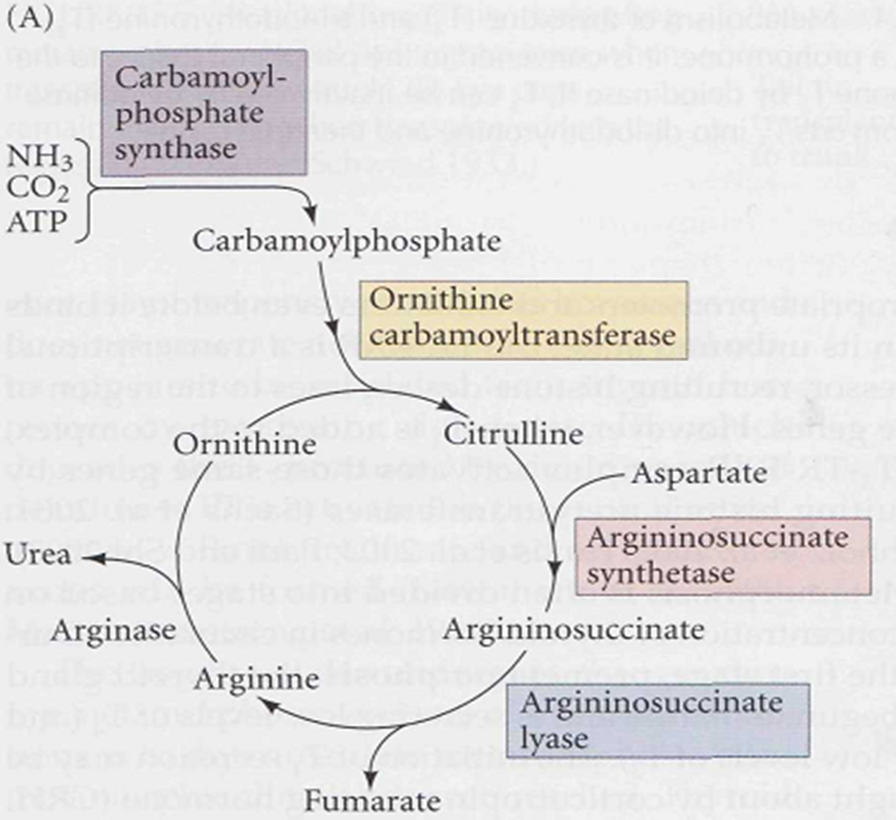
Development of the urea cycle during anuran metamorphosis. (A) Major features of the urea cycle, by which nitrogenous wastes are detoxified and excreted with minimal water loss.
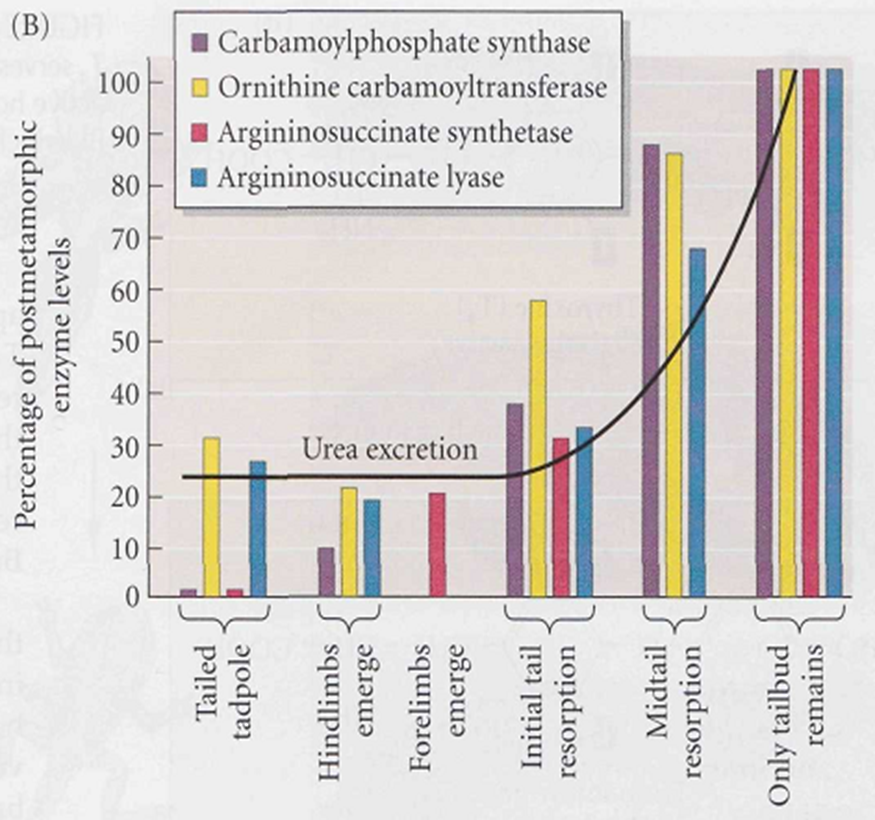
B)The emergence of urea-cycle enzyme activities correlates with metamorphic changes in the frog Rana catesbeiana.