Introduction to polyspermy
The entrance of multiple sperm polyspermy leads to disastrous consequences in most organisms.
In the sea urchin, fertilization by two sperm results in a triploid nucleus, in which each chromosome is represented three times rather than twice.
Normally each sperm’s centriole divides to form the two poles of a mitotic apparatus, the triploid chromosomes may be divided into as many as four cells.
Because there is no mechanism to ensure that each of the four cells receives the proper number and type of chromosomes, the chromosomes are apportioned unequally.
Some cells receive extra copies of certain chromosomes, while other cells lack them

1-Fast block to POLYSPERMY
The fast block to polyspermy is achieved by changing the electric potential of the egg cell membrane.
This membrane provides a selective barrier between the egg cytoplasm and the outside environment, so that ion concentrations within the egg differ greatly from those of its surroundings.
This concentration difference is especially significant for sodium and potassium ions. Seawater has a particularly high sodium ion (Na+) concentration, where-as the egg cytoplasm contains relatively little Na+.
The reverse is the case with potassium ions (K+). These concentration differences are maintained by the cell membrane, which steadfastly inhibits the entry of Na+ into the oocyte and prevents K+ from leaking out into the environment.
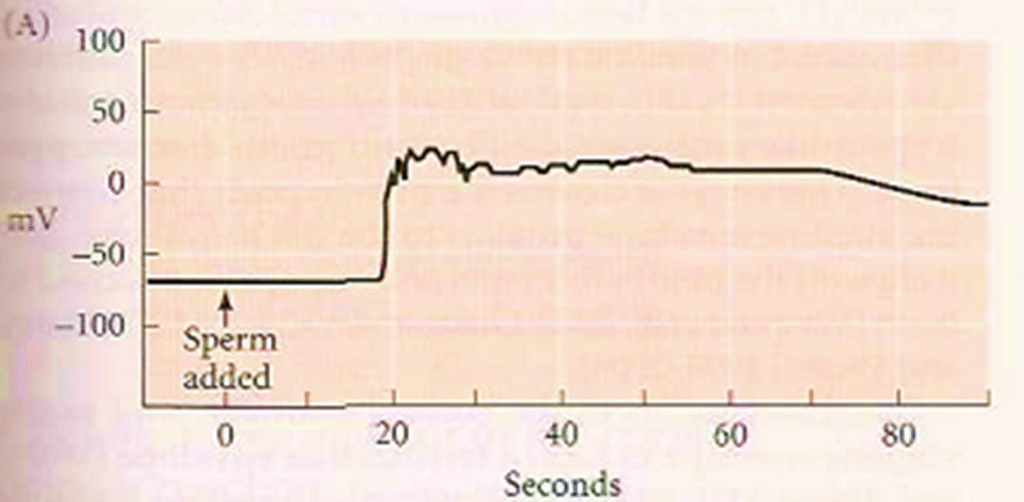
If we insert an electrode into an egg and place a second electrode outside it, we can measure the constant difference in charge across the egg cell membrane.
This resting membrane potential is generally about 70 mV, usually expressed as -70 mV because the inside of the cell is negatively charged with respect to the exterior. Within 1-3 seconds after the binding of the first sperm, the membrane potential shifts to a positive level, about +20 mV.
This change is caused by a small influx of Na+ into the egg.
Although sperm can fuse with membranes having a resting potential of -70 mV, they cannot fuse with membranes having a positive resting potential, so no more sperm can fuse to the egg.
It is not known whether the increased sodium permeability of the egg is due to the binding of the first sperm, or to the fusion of the first sperm with the egg.uRecent data suggest that the fusogenic region of bindin will not function
on a positively charged surface.
2-The slow block to polyspermy
The fast block to polyspermy is transient, since the membrane potential of the sea urchin egg remains positive for only about a minute.
This brief potential shift is not sufficient to prevent polyspermy permanently, and polyspermy can still occur if the sperm bound to the vitelline envelope are not somehow removed.
This sperm removal is accomplished by the cortical granule reaction, a slower, mechanical block to polyspermy that becomes active about a minute after the first successful sperm-egg fusion. This reaction also known as the slow block to polyspermy is found in many animal species, including sea urchins and most mammals
Directly beneath the sea urchin egg cell membrane are about 15,000 cortical granules, each about 1 um in diameter.
Upon sperm entry, these cortical granules fuse with the egg cell membrane and release their contents into the space between the cell membrane and the fibrous mat of vitelline envelope proteins.
Several proteins are released by this cortical granule exocytosis.
One is a trypsin-like protease called cortical granule serine protease.
This enzyme cleaves the protein posts that connect the vitelline envelope proteins to the cell membrane, and it clips of the bindin receptors, and any sperm attached to them
The components of the cortical granules bind to the vitelline envelope to form a fertilization envelope.
This fertilization envelope is elevated from the cell membrane by glycosaminoglycans released by the cortical granules.
These viscous compounds absorb water to expand the space between the cell membrane and the fertilization envelope, so that the envelope moves radially away from the egg.
The fertilization envelope is then stabilized by crosslinking adjacent proteins through egg-specific peroxidase enzymes and a transglutaminase released from the cortical granules.
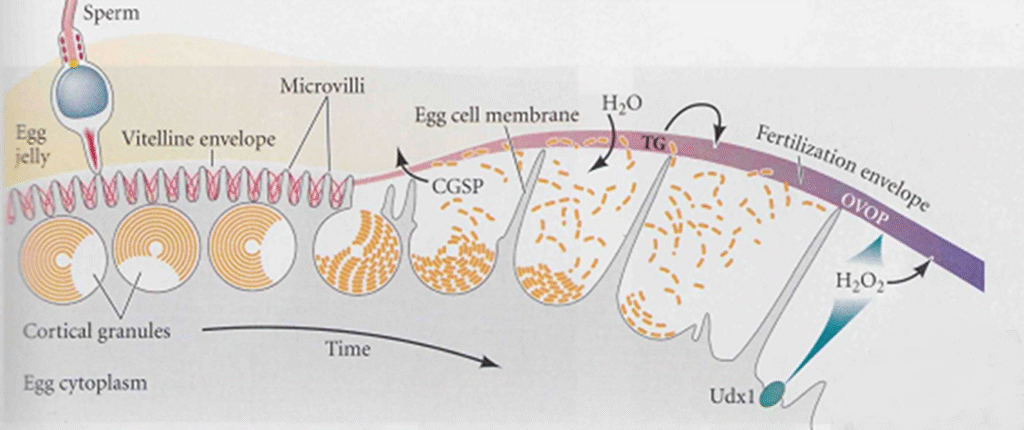
The fertilization envelope starts to form at the site of sperm entry and continues its expansion around the egg.
This process starts about 20 seconds after sperm attachment and is complete by the end of the first minute of fertilization.
As this happening, a fourth set of cortical granule proteins, including hyalin, forms a coating around the egg.
The egg extends elongated microvilli whose tips attach to this hyaline layer. This layer provides support for the blastomeres during cleavage.