Introduction
All the material necessary for the beginning of growth and development must be stored in the egg, or ovum.
Whereas the sperm eliminates most of its cytoplasm as it matures, the developing egg (called the oocyte before it reaches the stage of meiosis at which it is fertilized”) not only conserves the material it has but actively accumulates more.
The meiotic divisions that form the oocyte conserve its cytoplasm rather than giving half of it away (see Figure 16.30); at the same time, the oocyte either synthesizes or absorbs protein such as yolk that act as food reservoirs for the developing embryo.
So, even though sperm and egg have equal haploid nuclear components, the egg also accumulates a remarkable cytoplasmic storehouse during its maturation.
Detail of cytoplasmic store house of egg
1-Nutritive proteins.
It will be a long time before the embryo is able to feed itself or even obtain food from its mother, so the early embryonic cells need a supply of energy and amino acids.
In many species, this is accomplished by accumulating yolk proteins in the egg. Many of these yolk proteins are made in other organs (e.g., liver, fat bodies) and travel through the maternal blood to the oocyte.
2-Ribosomes and tRNA.
The early embryo needs to make many of its own structural proteins and enzymes, and in some species, there is a burst of protein synthesis soon after fertilization. Protein synthesis is accomplished by ribosomes and tRNA that exist in the egg.
The developing egg has special mechanisms for synthesizing ribosomes; certain amphibian oocytes produce as many as 10*12ribosomes during their meiotic prophase.
3-Messenger RNAs.
The oocyte not only accumulates proteins, but it also accumulates mRNAs that encode proteins for the early stages of development.
It is estimated that sea urchin eggs contain thousands of different types of mRNA that remain repressed until after fertilization.
4-Morphogenic factors.
Molecules that direct the differentiation of cells into certain cell types are present in the egg. These include transcription factors and paracrine factors.
In many species, they are localized in different regions of the egg and become segregated into different cells during cleavage.
5-Protective chemicals.
The embryo cannot run away from predators or move to a safer environment, so it must come equipped to deal with threats. Many eggs contain ultraviolet filters and DNA repair enzymes that protect them from sunlight.
Some eggs contain molecules that potential predators find distasteful, and the yolk of bird eggs even contains antibodies.
Structure of Egg:
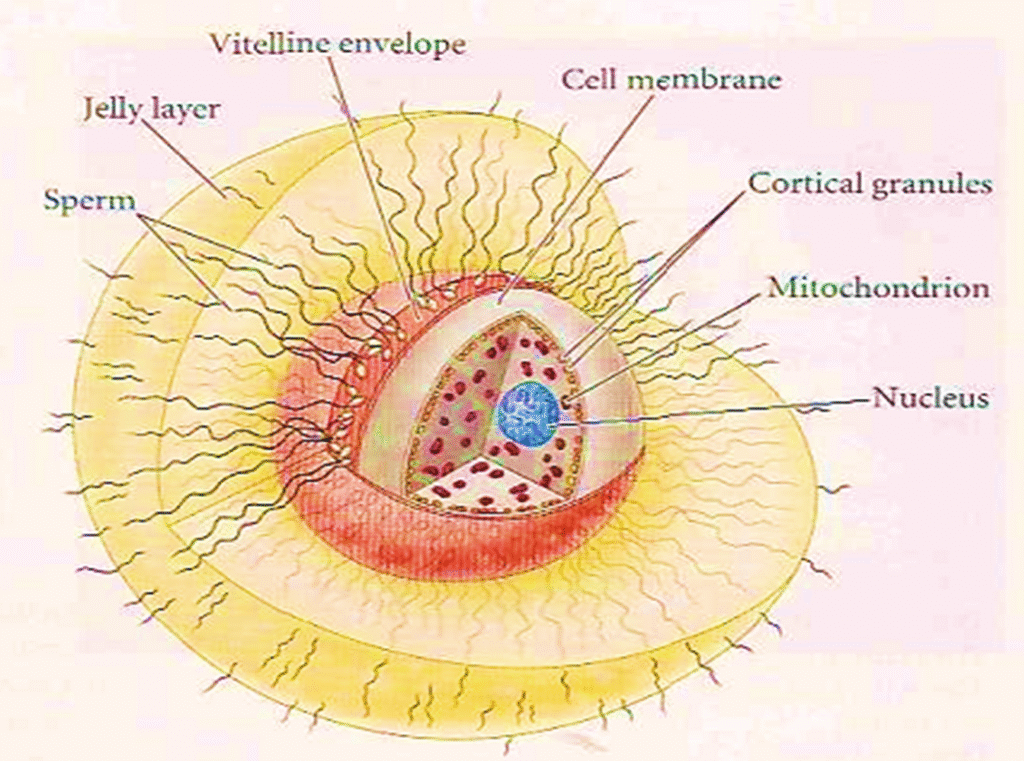
1- Cell Membrane
Enclosing the cytoplasm is the egg cell membrane. This membrane must be capable of fusing with the sperm cell membrane and must regulate the flow of certain ions during fertilization.
2- Vitelline Envelope:
Outside the cell membrane is an extracellular matrix that forms a fibrous mat around the egg and is often involved in sperm-egg recognition.
In invertebrates, this structure is usually called the vitelline envelope. The vitelline envelope contains several different glycoproteins.
It is supplemented by extensions of membrane glycoproteins from the cell membrane and by proteinaceous “posts ” that adhere the vitelline envelope to the membrane. The vitelline envelope is essential for the species-specific binding of sperm.
Many types of eggs also have a layer of egg jelly outside the vitelline envelope. This glycoprotein meshwork can have numerous functions, but most commonly it is used either to attract or to activate sperm.
The egg, then, is a cell specialized for receiving sperm and initiating development.
3- Zona pellucida
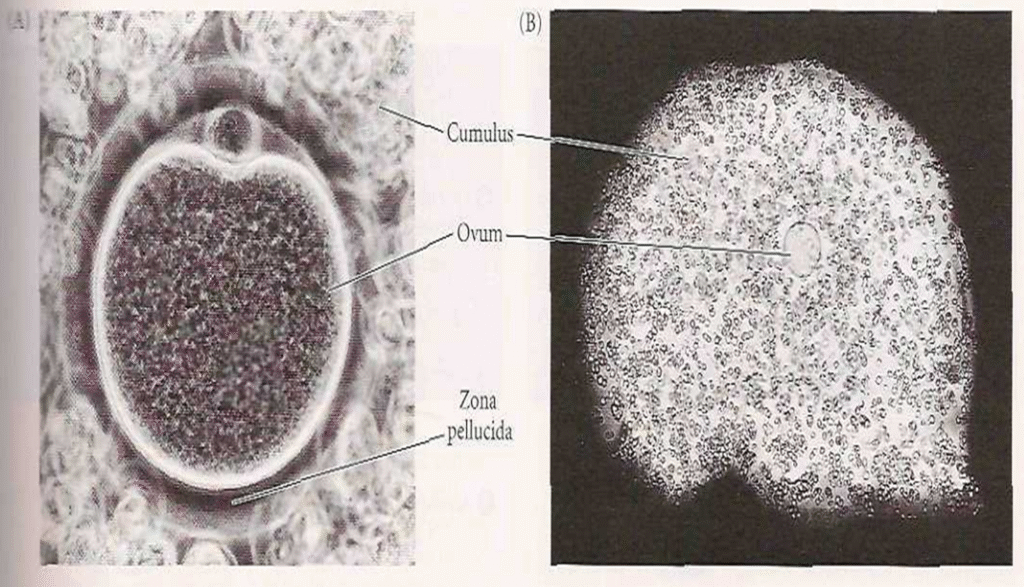
In mammalian eggs, the extracellular envelope is a separate and thick matrix called the zona pellucida.
4- Cumulus
The mammalian egg is also surrounded by a layer of cells called the cumulus, which is made up of the ovarian follicular cells that were nurturing the egg at the time of its release from the ovary. Mammalian sperm have to get past these cells to fertilize the egg.
The innermost layer of cumulus cells, immediately adjacent to the zona pellucida, is called the corona radiata.
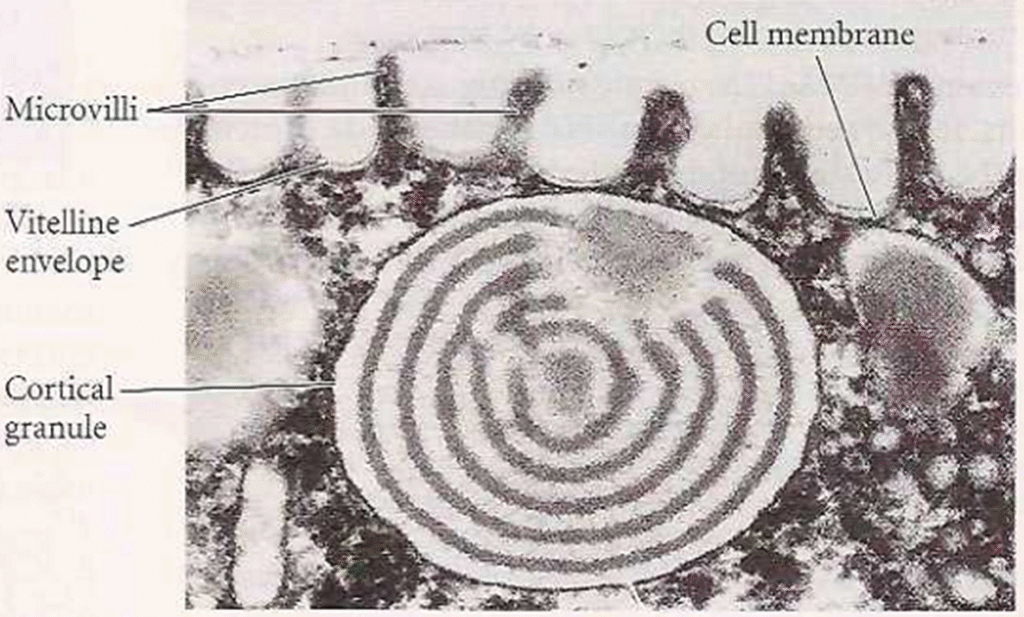
Lying immediately beneath the cell membrane of most egg is a thin layer (about 5 um) of gel-like cytoplasm called the cortex.
The cytoplasm in this region is stiffer than the internal cytoplasm and contains high concentration of globular actin molecules. During fertilization, these actin molecules polymerize to form long cables of actin known as Microfilaments.
Microfilaments are necessary for cell division. They are also used to extend the egg surface into small projections called Microvilli, which may aid sperm entry into the cell.
Also within the cortex are the cortical granules. These membrane-bound, Golgi-derived structures contain proteolytic enzymes and are thus homologous to the acrosomal vesicle of the sperm.
Moreover, in addition to digestive enzymes, the cortical granules contain mucopolysaccharides, adhesive glycoproteins, and hyalin protein.