•Distinctions between gustation and olfaction.
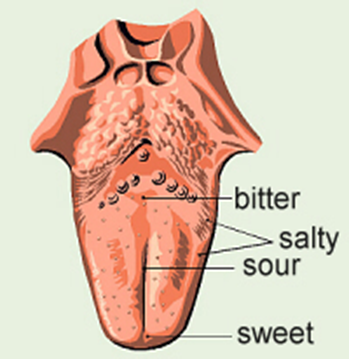
Gustation used to detect and identify food-related chemicals in near environment.
Olfaction used not just to detect food, also detection of enemies and mates.
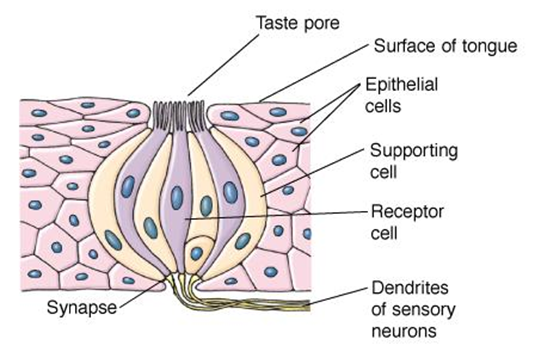
The gustatory system: Taste bud
·Gustatory receptors found in clusters- taste buds, receptors an axonal but generate APs.
·Gustatory receptors on tongue, throat, and mouth synapse with afferent fibers that travel to brain via 3 cranial nerves.
Gustatory transduction
•Two kinds of transduction mechanisms:
1) Direct effect of chemical on one or more ion channels in receptor
2) Second messenger pathway that indirectly changes flow of ions through channels.
Sour and salty stimuli transmission
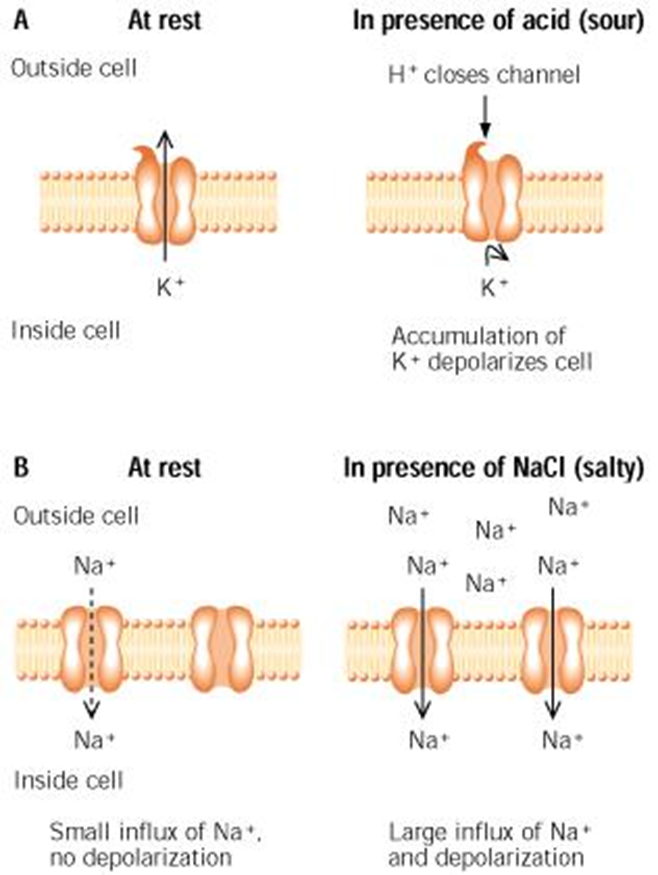
Substances that evoke sour or salty taste exert effects by directly influencing ion channels in membrane of receptor
•Weak acid vinegar ionize in water to produce protons (H+) and anions (- ions), in mud puppy, H+ ions block specific type of K+ channel in receptor
•For salty substances like table salt Na+ and other cations act as stimuli, Na+ ions of salt enter receptor Na+ channels directly, depolarizing cell, anion exerts some other effect, taste of sodium chloride distinct from sodium bicarbonate.
Sweet stimuli
·Produce response via 2nd messenger, but many kinds of receptors, even in single species.
Transmission
·Binding of sucrose to receptor activates specific G protein, activates enzyme adenylyl cyclase, catalyses’ the conversion of ATP to cyclic adenosine monophosphate (cAMP), turns on cAMP dependent protein kinase A, protein kinase phosphorylates K+ channel in cell membrane, causes closing, reduction in K+ efflux, depolarization, possible AP.
•Because variety of receptors, responses vary, not all sweet substances taste same
•Rate of adaptation to different sweet stimuli not same, perception of sweet taste of saccharine declines more than twice as fast as sweet taste of sugar on successive samples.
Bitter stimuli
•1) Direct effect on ion channels- blockage of K+ channels
•2) Receptor controlled ion pump- activation of chloride pump depolarizes
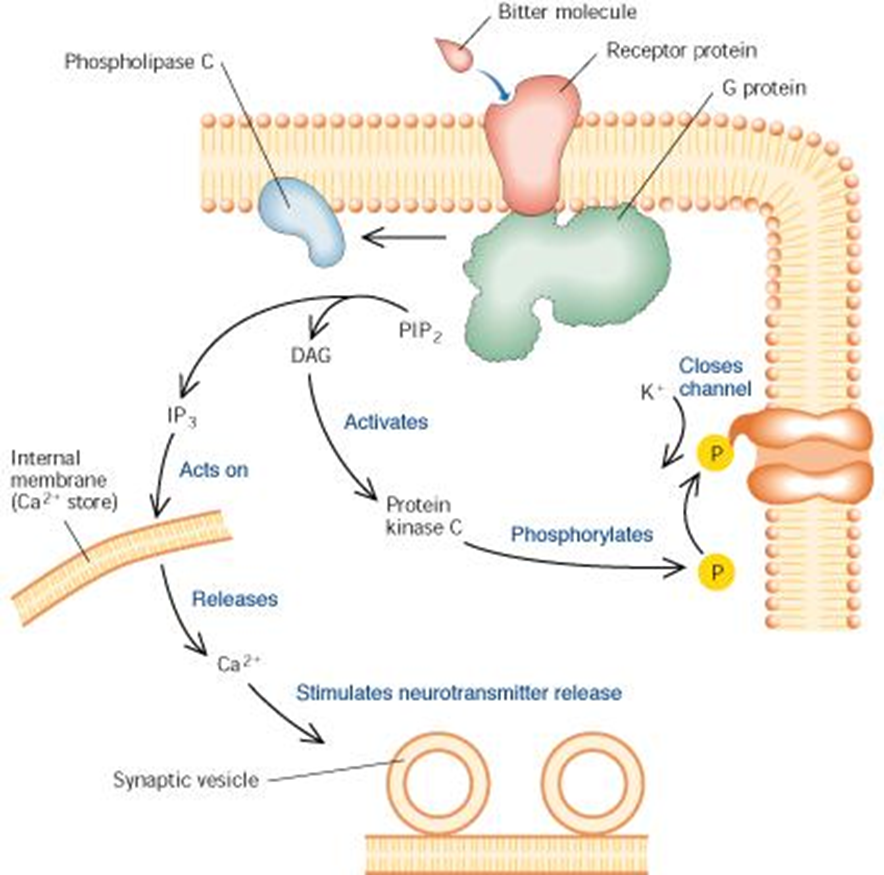
•3) Second messenger systems- example two pathway system, one path releases Ca2+ which directly causes transmitter release, other closes K+ channel causing depolarization, also some bitter receptors have pathway remarkably like rod and cone pathway, G protein 90% similar to transductin in rods and cones called gustductin, activates phosphodiesterase (PDE) that catalyses’ breakdown of cAMP, rod transductin itself also found in taste cells.
Umami taste
•Amino acids
•Some animals have gustatory receptor cells that respond to amino acids, to humans, most amino acids taste bitter, alanine and serine sweet, a few such as salts of glutamic acid have unique taste, umami, neither sour, salty, sweet, or bitter.
Transduction
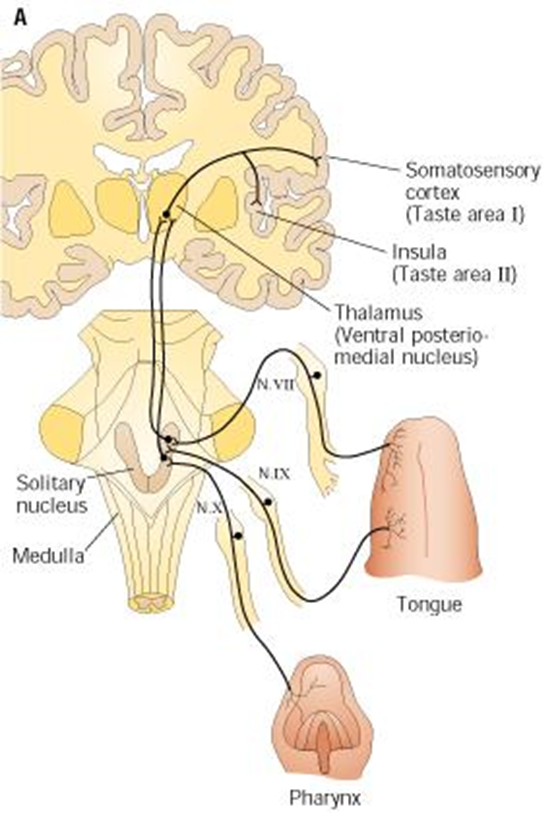
•In humans, afferent fibers from tip of tongue travel via facial nerve (cranial nerve VII), back of tongue via glossopharyngeal nerve (IX), pharynx via vagus nerve (X)
•After entering brainstem all gustatory afferents synapse in solitary nuclear complex of medulla.
·In primates two cortical areas known to be involved in taste processing, facial part of somatosensory cortex, and insula.
Olfactory transduction
•In land animals, odorant must dissolve in mucus or fluid covering receptors
•Odorant binding proteins bind with dissolved odorant, move to receptor cell membrane
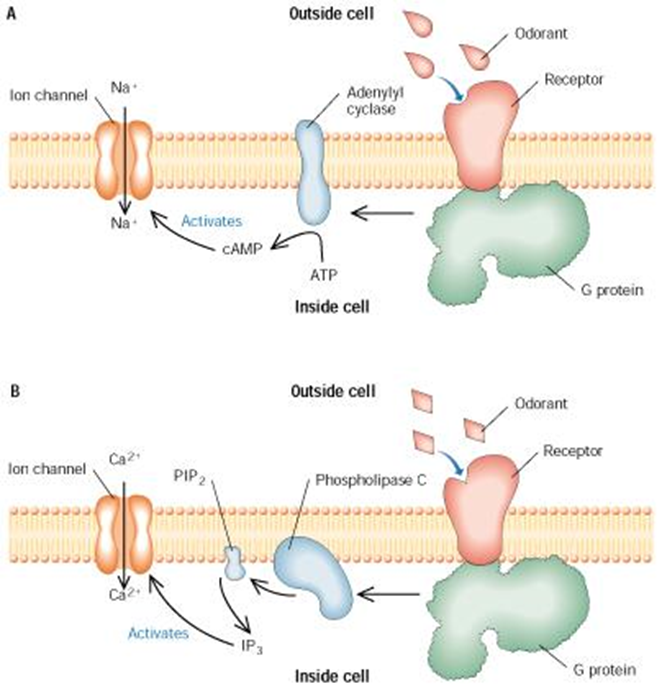
•Two transduction pathways in vertebrate olfactory neurons, each with G protein second messenger cascade and ligand gated ion channel, both pathways may be present in one neuron.
Olfactory transmission
•A) G protein linked to adenylyl cyclase, promotes synthesis of cAMP, opens non-specific cation channel, depolarizes cell
•B) G protein activates phospholipase C, stimulates production of IP3 and DAG, IP3 may act on Ca2+ channel.
The olfactory system
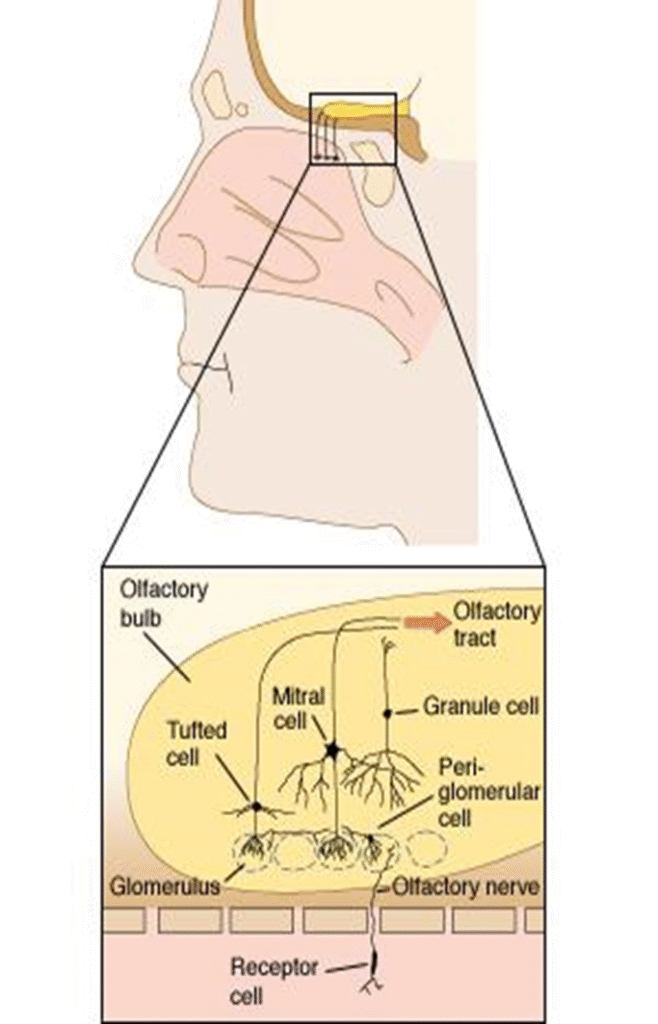
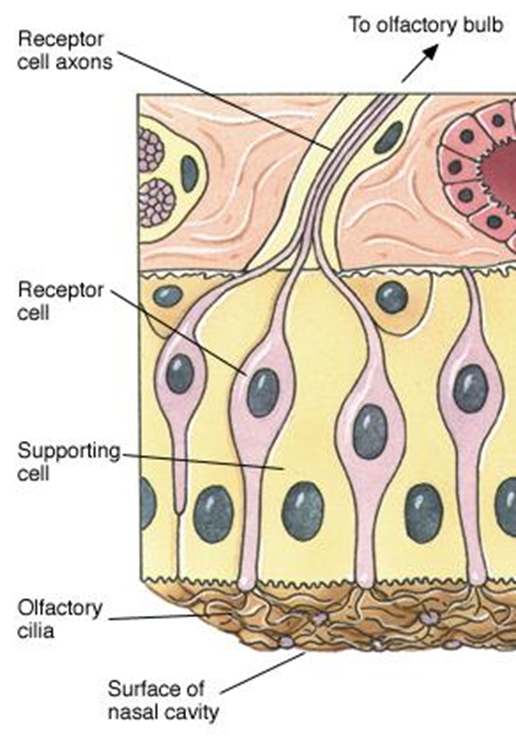
·Olfactory receptors line nasal epithelium, axon extends through pores in bones of skull, dendrite has branches, olfactory cilia that contain receptor proteins for odorants, protected by thin layer of mucus.
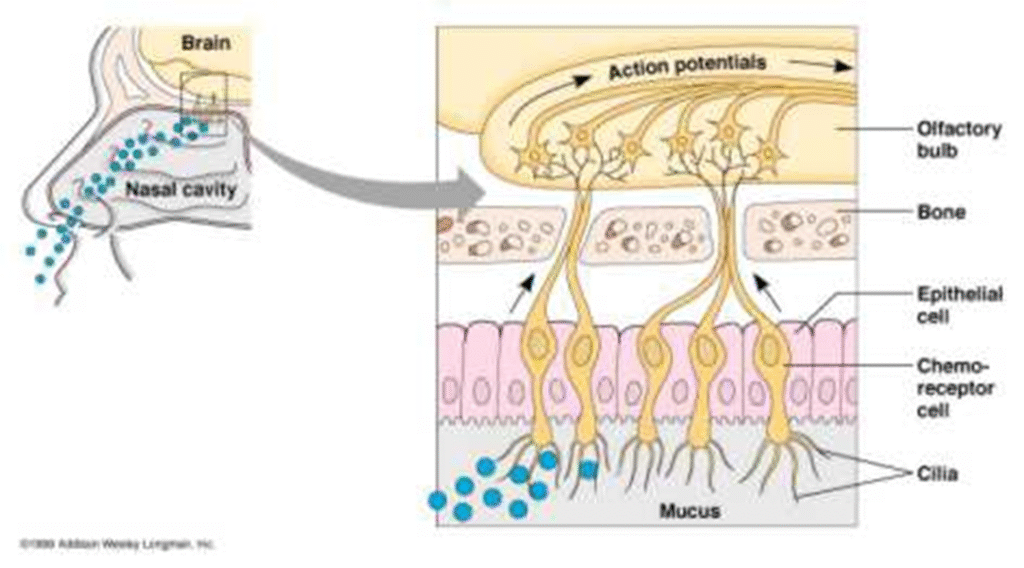
•Receptors send axons to olfactory bulb, in primates lies over nose, in other vertebrates posterior to nose
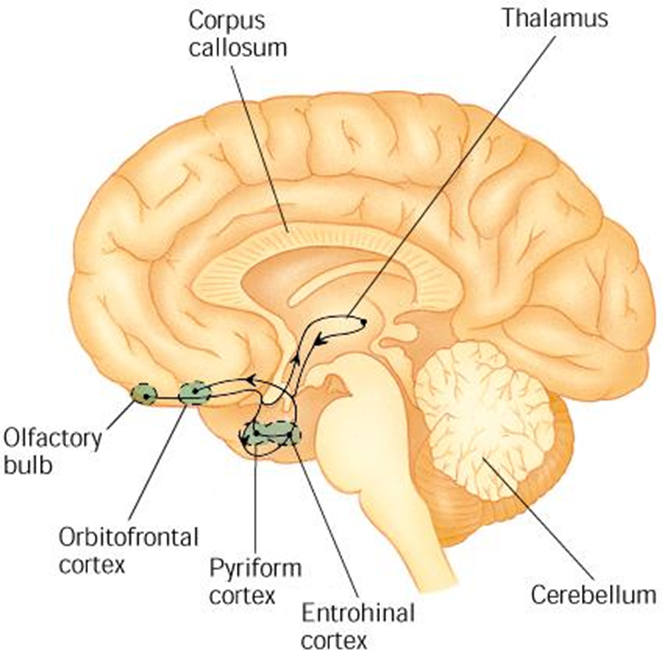
•Axons from olfactory bulb enter brain via olfactory tract (cranial nerve I), project to primary olfactory cortex or pyriform cortex on anteroventral of telencephalon, no passage through thalamus.
References
Animal physiology by Eckert,4th edition