Composition and Properties of Urine
•Appearance
–almost colorless to deep amber; yellow color due to urochrome, from breakdown of hemoglobin (RBC’s)
•Odor – as it stands bacteria degrade urea to ammonia
•Specific gravity
–density of urine ranges from 1.000 -1.035
•Osmolarity – (blood – 300 mOsm/L) ranges from
50 mOsm/L to 1,200 mOsm/L in dehydrated person
•pH – range: 4.5 – 8.2, usually 6.0
•Chemical composition: 95% water, 5% solutes
–urea, NaCl, KCl, creatinine, uric acid
Urine Volume
•Normal volume – 1 to 2 L/day
•Polyuria > 2L/day
•Oliguria < 500 mL/day
•Anuria – 0 to 100 mL
Urine Abnormalities Reasons
1-Diabetes
•Chronic polyuria of metabolic origin
•With hyperglycemia and glycosuria
–diabetes mellitus I and II, insulin hyposecretion/insensitivity
–gestational diabetes, 1 to 3% of pregnancies
–pituitary diabetes, hypersecretion of GH
–adrenal diabetes, hypersecretion of cortisol
•With glycosuria but no hyperglycemia
–renal diabetes, hereditary deficiency of glucose transporters
•With no hyperglycemia or glycosuria
–diabetes insipidus, ADH hyposecretion
Diuretics
•Effects
– urine output
– blood volume
•Uses
–hypertension and congestive heart failure
•Mechanisms of action
– GFR
– tubular reabsorption
Urine Storage and Elimination
•Ureters
–from renal pelvis passes dorsal to bladder and enters it from below, about 25 cm long
–3 layers
•adventitia – muscularis – 2 layers of smooth muscle
–urine enters, it stretches and contracts in peristaltic wave
•mucosa – transitional epithelium
–lumen very narrow, easily obstructed
Urinary Bladder and Urethra – Female

1-Urinary Bladder
•Located in pelvic cavity, posterior to pubic symphysis
•3 layers
–parietal peritoneum, superiorly; fibrous adventitia rest
–muscularis: detrusor muscle, 3 layers of smooth muscle
–mucosa: transitional epithelium
•trigone: openings of ureters and urethra, triangular
•rugae: relaxed bladder wrinkled, highly distensible
•capacity: moderately full – 500 ml, max. – 800 ml
2-Female Urethra
•3 to 4 cm long
•External urethral orifice
–between vaginal orifice and clitoris
•Internal urethral sphincter
–detrusor muscle thickened, smooth muscle, involuntary control
Male Bladder and Urethra
•18 cm long
•Internal urethral sphincter
•External urethral sphincter
•3 regions
–prostatic urethra
•during orgasm receives semen
–membranous urethra
•passes through pelvic cavity
–penile urethra
Voiding Urine – Micturition
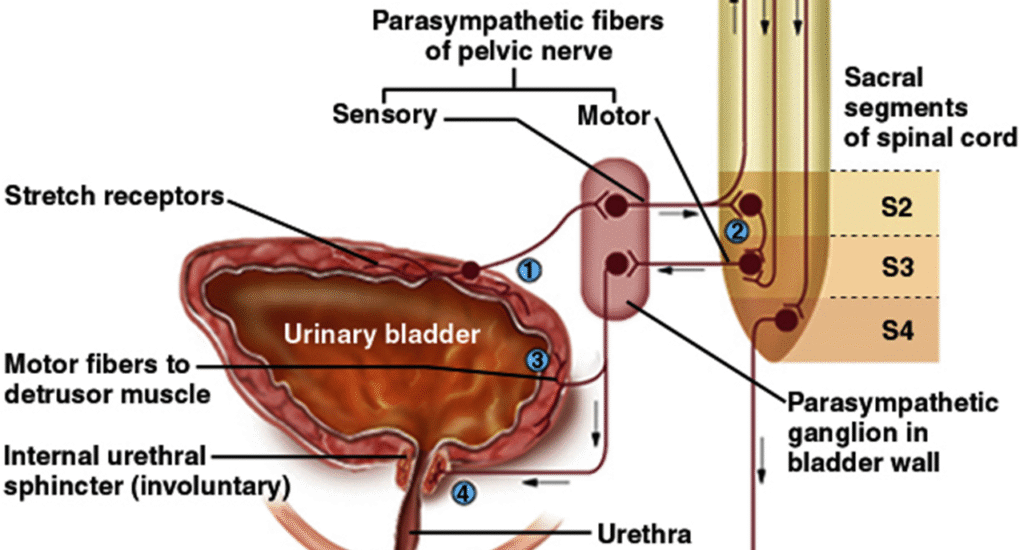
•Micturition reflex
1) 200 ml urine in bladder, stretch receptors send signal to spinal cord (S2, S3)
2) parasympathetic reflex arc from spinal cord, stimulates contraction of detrusor muscle
3) relaxation of internal urethral sphincter 4) this reflex predominates in infants
Infant Micturition Reflex Diagram
Voluntary Control of Micturition
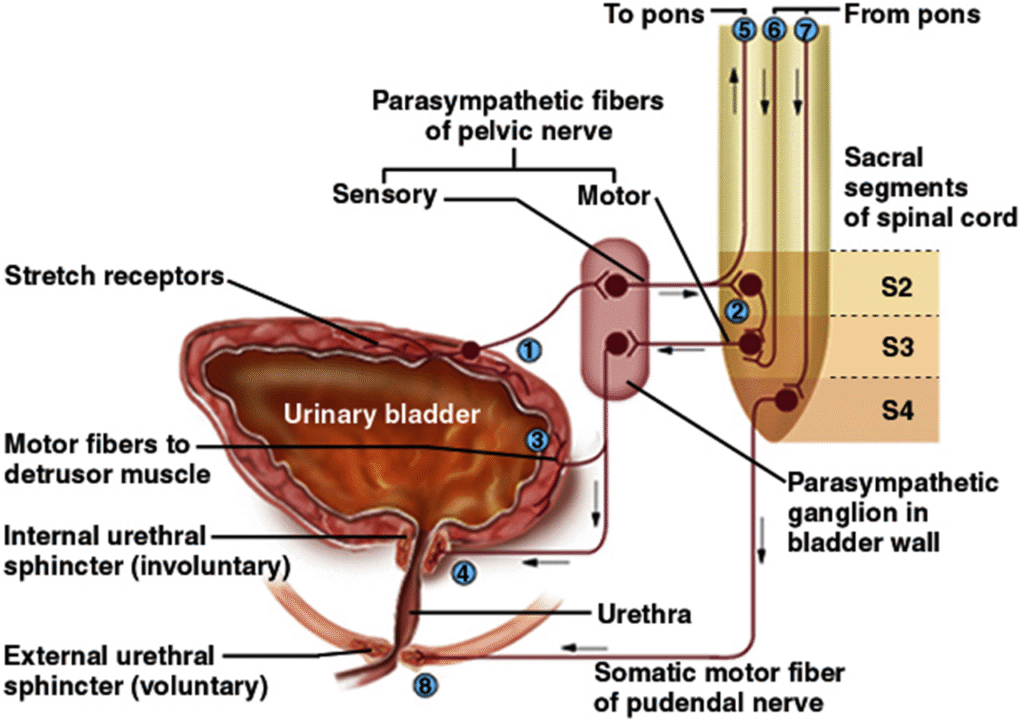
micturition center in pons receives stretch signals and integrates cortical input (voluntary control)
6) sends signal for stimulation of detrussor and relaxes internal urethral sphincter
7) to delay urination impulses sent through pudendal nerve to external urethral sphincter keep it contracted until you wish to urinate
8) valsalva maneuver
–aids in expulsion of urine by pressure on bladder
–can also activate micturition reflex voluntarily
Adult Micturition Reflex Diagram
Reference
Animal physiology by Eckert,4th edition